Mie potential: Difference between revisions
Jump to navigation
Jump to search
Carl McBride (talk | contribs) m (→Second virial coefficient: Added lint to an Erratum) |
Carl McBride (talk | contribs) m (→References: Added a recent publiaction) |
||
| Line 28: | Line 28: | ||
*[http://dx.doi.org/10.1016/j.molliq.2016.12.026 I.M. Zerón, L.A. Padilla, F. Gámez, J. Torres-Arenas, A.L. Benavides "Discrete perturbation theory for Mie potentials", Journal of Molecular Liquids '''229''' pp. 125-136 (2017)] | *[http://dx.doi.org/10.1016/j.molliq.2016.12.026 I.M. Zerón, L.A. Padilla, F. Gámez, J. Torres-Arenas, A.L. Benavides "Discrete perturbation theory for Mie potentials", Journal of Molecular Liquids '''229''' pp. 125-136 (2017)] | ||
*[http://dx.doi.org/10.1080/00268976.2016.1206218 Stephan Werth, Katrin Stöbener, Martin Horsch and Hans Hasse "Simultaneous description of bulk and interfacial properties of fluids by the Mie potential", Molecular Physics '''115''' pp. 1017-1030 (2017)] | *[http://dx.doi.org/10.1080/00268976.2016.1206218 Stephan Werth, Katrin Stöbener, Martin Horsch and Hans Hasse "Simultaneous description of bulk and interfacial properties of fluids by the Mie potential", Molecular Physics '''115''' pp. 1017-1030 (2017)] | ||
*[https://doi.org/10.1063/1.5041320 Richard J. Sadus "Second virial coefficient properties of the n-m Lennard-Jones/Mie potential", Journal of Chemical Physics 149, 074504 (2018)] | |||
[[Category: Models]] | [[Category: Models]] | ||
Latest revision as of 14:11, 12 September 2018
The Mie potential was proposed by Gustav Mie in 1903 [1]. It is given by
- Failed to parse (SVG (MathML can be enabled via browser plugin): Invalid response ("Math extension cannot connect to Restbase.") from server "https://wikimedia.org/api/rest_v1/":): {\displaystyle \Phi_{12}(r) = \left( \frac{n}{n-m}\right) \left( \frac{n}{m}\right)^{m/(n-m)} \epsilon \left[ \left(\frac{\sigma}{r} \right)^{n}- \left( \frac{\sigma}{r}\right)^m \right] }
where:
- Failed to parse (SVG (MathML can be enabled via browser plugin): Invalid response ("Math extension cannot connect to Restbase.") from server "https://wikimedia.org/api/rest_v1/":): {\displaystyle r := |\mathbf{r}_1 - \mathbf{r}_2|}
- Failed to parse (SVG (MathML can be enabled via browser plugin): Invalid response ("Math extension cannot connect to Restbase.") from server "https://wikimedia.org/api/rest_v1/":): {\displaystyle \Phi_{12}(r) } is the intermolecular pair potential between two particles at a distance r;
- Failed to parse (SVG (MathML can be enabled via browser plugin): Invalid response ("Math extension cannot connect to Restbase.") from server "https://wikimedia.org/api/rest_v1/":): {\displaystyle \sigma } is the value of Failed to parse (SVG (MathML can be enabled via browser plugin): Invalid response ("Math extension cannot connect to Restbase.") from server "https://wikimedia.org/api/rest_v1/":): {\displaystyle r} at Failed to parse (SVG (MathML can be enabled via browser plugin): Invalid response ("Math extension cannot connect to Restbase.") from server "https://wikimedia.org/api/rest_v1/":): {\displaystyle \Phi(r)=0} ;
- Failed to parse (SVG (MathML can be enabled via browser plugin): Invalid response ("Math extension cannot connect to Restbase.") from server "https://wikimedia.org/api/rest_v1/":): {\displaystyle \epsilon } : well depth (energy)
Note that when Failed to parse (SVG (MathML can be enabled via browser plugin): Invalid response ("Math extension cannot connect to Restbase.") from server "https://wikimedia.org/api/rest_v1/":): {\displaystyle n=12} and Failed to parse (SVG (MathML can be enabled via browser plugin): Invalid response ("Math extension cannot connect to Restbase.") from server "https://wikimedia.org/api/rest_v1/":): {\displaystyle m=6} this becomes the Lennard-Jones model.
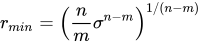
The location of the potential minimum is given by
(14,7) model[edit]
Second virial coefficient[edit]
The second virial coefficient [4] [5] [6] and the Vliegenthart–Lekkerkerker relation [7].
References[edit]
- ↑ Gustav Mie "Zur kinetischen Theorie der einatomigen Körper", Annalen der Physik 11 pp. 657-697 (1903) (Note: check the content of this reference)
- ↑ Afshin Eskandari Nasrabad "Monte Carlo simulations of thermodynamic and structural properties of Mie(14,7) fluids", Journal of Chemical Physics 128 154514 (2008)
- ↑ Afshin Eskandari Nasrabad, Nader Mansoori Oghaz, and Behzad Haghighi "Transport properties of Mie(14,7) fluids: Molecular dynamics simulation and theory", Journal of Chemical Physics 129 024507 (2008)
- ↑ D. M. Heyes, G. Rickayzen, S. Pieprzyk and A. C. Brańka "The second virial coefficient and critical point behavior of the Mie Potential", Journal of Chemical Physics 145 084505 (2016)
- ↑ D. M. Heyes and T. Pereira de Vasconcelos "The second virial coefficient of bounded Mie potentials", Journal of Chemical Physics 147 214504 (2017)
- ↑ D. M. Heyes and  T. Pereira de Vasconcelos "Erratum: “The second virial coefficient of bounded Mie potentials” [J. Chem. Phys. 147, 214504 (2017)]", Journal of Chemical Physics 148 169903 (2018)
- ↑ V. L. Kulinskii "The Vliegenthart–Lekkerkerker relation: The case of the Mie-fluids", Journal of Chemical Physics 134 144111 (2011)
Related reading
- Pedro Orea, Yuri Reyes-Mercado, Yurko Duda "Some universal trends of the Mie(n,m) fluid thermodynamics", Physics Letters A 372 pp. 7024-7027 (2008)
- N.S. Ramrattan, C. Avendaño, E.A. Müller and A. Galindo "A corresponding-states framework for the description of the Mie family of intermolecular potentials", Molecular Physics 113 pp. 932-947 (2015)
- I.M. Zerón, L.A. Padilla, F. Gámez, J. Torres-Arenas, A.L. Benavides "Discrete perturbation theory for Mie potentials", Journal of Molecular Liquids 229 pp. 125-136 (2017)
- Stephan Werth, Katrin Stöbener, Martin Horsch and Hans Hasse "Simultaneous description of bulk and interfacial properties of fluids by the Mie potential", Molecular Physics 115 pp. 1017-1030 (2017)
- Richard J. Sadus "Second virial coefficient properties of the n-m Lennard-Jones/Mie potential", Journal of Chemical Physics 149, 074504 (2018)