Ornstein-Zernike relation: Difference between revisions
Carl McBride (talk | contribs) m (→References: Corrected reference.) |
Carl McBride (talk | contribs) (→References: Added a recent publication) |
||
| (7 intermediate revisions by 4 users not shown) | |||
| Line 1: | Line 1: | ||
Notation: | <div style="border:1px solid #f3f3ff; padding-left: 0.5em !important; background-color: #f3f3ff; border-width: 0 0 0 1.4em; clear:right; float:right;"> | ||
Notation used: | |||
*<math>g(r)</math> is the [[Pair distribution function | pair distribution function]]. | *<math>g(r)</math> is the [[Pair distribution function | pair distribution function]]. | ||
*<math>\Phi(r)</math> is the [[Intermolecular pair potential | pair potential]] acting between pairs. | *<math>\Phi(r)</math> is the [[Intermolecular pair potential | pair potential]] acting between pairs. | ||
| Line 9: | Line 10: | ||
*<math>\omega(r)</math> is the [[Thermal potential | thermal potential]]. | *<math>\omega(r)</math> is the [[Thermal potential | thermal potential]]. | ||
*<math>f(r)</math> is the [[Mayer f-function]]. | *<math>f(r)</math> is the [[Mayer f-function]]. | ||
</div> | |||
The '''Ornstein-Zernike relation''' integral equation <ref>L. S. Ornstein and F. Zernike "Accidental deviations of density and opalescence at the critical point of a single substance", Koninklijke Nederlandse Akademie van Wetenschappen Amsterdam Proc. Sec. Sci. '''17''' pp. 793- (1914)</ref> is given by: | |||
The '''Ornstein-Zernike relation''' ( | |||
:<math>h=h\left[c\right]</math> | :<math>h=h\left[c\right]</math> | ||
where <math>h[c]</math> denotes a functional of <math>c</math>. This relation is exact. | where <math>h[c]</math> denotes a functional of <math>c</math>. This relation is exact. | ||
| Line 19: | Line 20: | ||
Because of this <math>h</math> must be determined self-consistently. | Because of this <math>h</math> must be determined self-consistently. | ||
This need for self-consistency is characteristic of all many-body problems. | This need for self-consistency is characteristic of all many-body problems. | ||
(Hansen and McDonald, section 5.2 p. 106) For a system in an external field, the | (Hansen and McDonald, section 5.2 p. 106) For a system in an external field, the Ornstein-Zernike relation has the form (5.2.7) | ||
:<math>h(1,2) = c(1,2) + \int \rho^{(1)}(3) c(1,3)h(3,2) d3</math> | :<math>h(1,2) = c(1,2) + \int \rho^{(1)}(3) c(1,3)h(3,2) d3</math> | ||
If the system is both homogeneous and isotropic, the | If the system is both homogeneous and isotropic, the Ornstein-Zernike relation becomes (Eq. 6 of Ref. 1) | ||
:<math>\gamma ({\mathbf r}) \equiv h({\mathbf r}) - c({\mathbf r}) = \rho \int h({\mathbf r'})~c(|{\mathbf r} - {\mathbf r'}|) {\rm d}{\mathbf r'}</math> | :<math>\gamma ({\mathbf r}) \equiv h({\mathbf r}) - c({\mathbf r}) = \rho \int h({\mathbf r'})~c(|{\mathbf r} - {\mathbf r'}|) {\rm d}{\mathbf r'}</math> | ||
In words, this equation (Hansen and McDonald, section 5.2 p. 107) | In words, this equation (Hansen and McDonald, section 5.2 p. 107) | ||
:"...describes the fact that the ''total'' correlation between particles 1 and 2, represented by <math>h(1,2)</math>, is due in part to the ''direct'' correlation between 1 and 2, represented by <math>c(1,2)</math>, but also to the ''indirect'' correlation, <math>\gamma (r)</math>, propagated via increasingly large numbers of intermediate particles." | |||
Notice that this equation is basically a convolution, ''i.e.'' | Notice that this equation is basically a convolution, ''i.e.'' | ||
| Line 48: | Line 47: | ||
:::::''etc.'' | :::::''etc.'' | ||
Diagrammatically this expression can be written as ( | Diagrammatically this expression can be written as <ref>[http://dx.doi.org/10.1103/PhysRevA.45.816 James A. Given "Liquid-state methods for random media: Random sequential adsorption", Physical Review A '''45''' pp. 816-824 (1992)]</ref>: | ||
:[[Image:oz_diag.png]] | :[[Image:oz_diag.png]] | ||
| Line 54: | Line 53: | ||
where the bold lines connecting root points denote <math>c</math> functions, the blobs denote <math>h</math> functions. | where the bold lines connecting root points denote <math>c</math> functions, the blobs denote <math>h</math> functions. | ||
An arrow pointing from left to right indicates an uphill path from one root | An arrow pointing from left to right indicates an uphill path from one root | ||
point to another. An `uphill path' is a sequence of Mayer bonds passing through increasing | point to another. An `uphill path' is a sequence of [[Mayer f-function |Mayer bonds]] passing through increasing | ||
particle labels. | particle labels. | ||
The | The Ornstein-Zernike relation can be derived by performing a functional differentiation | ||
of the grand canonical distribution function | of the [[Grand canonical ensemble |grand canonical]] distribution function. | ||
== | ==Ornstein-Zernike relation in Fourier space== | ||
The Ornstein-Zernike equation may be written in [[Fourier analysis |Fourier space]] as (Eq. 5 | The Ornstein-Zernike equation may be written in [[Fourier analysis |Fourier space]] as (<ref>[http://dx.doi.org/10.1063/1.470724 Der-Ming Duh and A. D. J. Haymet "Integral equation theory for uncharged liquids: The Lennard-Jones fluid and the bridge function", Journal of Chemical Physics '''103''' pp. 2625-2633 (1995)]</ref> Eq. 5): | ||
:<math>\hat{\gamma} = ( | :<math>\hat{\gamma} = (\mathbf{I} - \rho \mathbf{\hat{c}})^{-1} \mathbf{\hat{c}} \rho \mathbf{\hat{c}}</math> | ||
The carets denote the three-dimensional Fourier transformed quantities which reduce explicitly | The carets denote the three-dimensional Fourier transformed quantities which reduce explicitly | ||
| Line 69: | Line 68: | ||
:<math>\gamma (r) = \frac{1}{2 \pi^2 r} \int_0^\infty k~\sin (kr) \hat{\gamma}( | :<math>\gamma (r) = \frac{1}{2 \pi^2 r} \int_0^\infty k~\sin (kr) \hat{\gamma}(k) dk</math> | ||
Note: | Note: | ||
| Line 79: | Line 78: | ||
==References== | ==References== | ||
<references/> | |||
'''Related reading''' | '''Related reading''' | ||
*Jean-Pierre Hansen and I.R. McDonald "Theory of Simple Liquids", Academic Press (2006) (Third Edition) ISBN 0-12-370535-5 § 3.5 | *Jean-Pierre Hansen and I.R. McDonald "Theory of Simple Liquids", Academic Press (2006) (Third Edition) ISBN 0-12-370535-5 § 3.5 | ||
*[http://doi.org/10.1063/1.4972020 Yan He, Stuart A. Rice, and Xinliang Xu "Analytic solution of the Ornstein-Zernike relation for inhomogeneous liquids", Journal of Chemical Physics '''145''' 234508 (2016)] | |||
[[Category: Integral equations]] | [[Category: Integral equations]] | ||
Latest revision as of 15:17, 21 December 2016
Notation used:
- is the pair distribution function.
- is the pair potential acting between pairs.
- is the total correlation function.
- is the direct correlation function.
- is the indirect (or series or chain) correlation function.
- is the cavity correlation function.
- is the bridge function.
- is the thermal potential.
- is the Mayer f-function.


The Ornstein-Zernike relation integral equation [1] is given by:
![{\displaystyle h=h\left[c\right]}](https://wikimedia.org/api/rest_v1/media/math/render/svg/e66a42d2a4fc9e2fdba525b2bf9fd63423158d36)
where denotes a functional of . This relation is exact. This is complemented by the closure relation
![{\displaystyle h[c]}](https://wikimedia.org/api/rest_v1/media/math/render/svg/e452ec3f3236026f5ef8925c3eade3105e6dd60a)

![{\displaystyle c=c\left[h\right]}](https://wikimedia.org/api/rest_v1/media/math/render/svg/3340b88402144027bfb655ef124c16d903cca221)
Note that depends on , and depends on . Because of this must be determined self-consistently. This need for self-consistency is characteristic of all many-body problems. (Hansen and McDonald, section 5.2 p. 106) For a system in an external field, the Ornstein-Zernike relation has the form (5.2.7)


If the system is both homogeneous and isotropic, the Ornstein-Zernike relation becomes (Eq. 6 of Ref. 1)

In words, this equation (Hansen and McDonald, section 5.2 p. 107)
- "...describes the fact that the total correlation between particles 1 and 2, represented by , is due in part to the direct correlation between 1 and 2, represented by , but also to the indirect correlation, , propagated via increasingly large numbers of intermediate particles."
Notice that this equation is basically a convolution, i.e.

(Note: the convolution operation written here as is more frequently written as ) This can be seen by expanding the integral in terms of (here truncated at the fourth iteration):






- etc.
Diagrammatically this expression can be written as [2]:

where the bold lines connecting root points denote functions, the blobs denote functions. An arrow pointing from left to right indicates an uphill path from one root point to another. An `uphill path' is a sequence of Mayer bonds passing through increasing particle labels. The Ornstein-Zernike relation can be derived by performing a functional differentiation of the grand canonical distribution function.
Ornstein-Zernike relation in Fourier space[edit]
The Ornstein-Zernike equation may be written in Fourier space as ([3] Eq. 5):

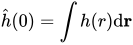
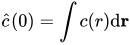
The carets denote the three-dimensional Fourier transformed quantities which reduce explicitly to:


Note:
References[edit]
- ↑ L. S. Ornstein and F. Zernike "Accidental deviations of density and opalescence at the critical point of a single substance", Koninklijke Nederlandse Akademie van Wetenschappen Amsterdam Proc. Sec. Sci. 17 pp. 793- (1914)
- ↑ James A. Given "Liquid-state methods for random media: Random sequential adsorption", Physical Review A 45 pp. 816-824 (1992)
- ↑ Der-Ming Duh and A. D. J. Haymet "Integral equation theory for uncharged liquids: The Lennard-Jones fluid and the bridge function", Journal of Chemical Physics 103 pp. 2625-2633 (1995)
Related reading
- Jean-Pierre Hansen and I.R. McDonald "Theory of Simple Liquids", Academic Press (2006) (Third Edition) ISBN 0-12-370535-5 § 3.5
- Yan He, Stuart A. Rice, and Xinliang Xu "Analytic solution of the Ornstein-Zernike relation for inhomogeneous liquids", Journal of Chemical Physics 145 234508 (2016)