Van der Waals equation of state: Difference between revisions
Carl McBride (talk | contribs) No edit summary |
Carl McBride (talk | contribs) m (→Critical point: Replaced P_c with p_c to be consistent) |
||
| (27 intermediate revisions by 3 users not shown) | |||
| Line 1: | Line 1: | ||
The van der Waals equation | The '''van der Waals equation of state''', developed by [[ Johannes Diderik van der Waals]] <ref>J. D. van der Waals "Over de Continuiteit van den Gas- en Vloeistoftoestand", doctoral thesis, Leiden, A,W, Sijthoff (1873)</ref> | ||
<ref>English translation: [http://store.doverpublications.com/0486495930.html J. D. van der Waals "On the Continuity of the Gaseous and Liquid States", Dover Publications ISBN: 0486495930]</ref>, takes into account two features that are absent in the [[Equation of State: Ideal Gas | ideal gas]] equation of state; the parameter <math> b </math> introduces somehow the repulsive behavior between pairs of molecules at short distances, | |||
it represents the minimum molar volume of the system, whereas <math> a </math> measures the attractive interactions between the molecules. The van der Waals equation of state leads to a liquid-vapor equilibrium at low temperatures, with the corresponding critical point. | |||
==Equation of state== | |||
The van der Waals equation of state can be written as | |||
:<math> \left | :<math>\left(p + \frac{an^2}{V^2}\right)\left(V-nb\right) = nRT</math> | ||
where: | where: | ||
* <math> p </math> is the pressure | * <math> p </math> is the [[pressure]], | ||
* <math> V </math> is the volume, | |||
* <math> n </math> is the number of moles, | |||
* <math> T </math> is the absolute [[temperature]], | |||
* <math> R </math> is the [[molar gas constant]]; <math> R = N_A k_B </math>, with <math> N_A </math> being the [[Avogadro constant]] and <math>k_B</math> being the [[Boltzmann constant]]. | |||
*<math>a</math> and <math>b</math> are constants that introduce the effects of attraction and volume respectively and depend on the substance in question. | |||
==Critical point== | |||
At the [[Critical points |critical point]] one has <math>\left.\frac{\partial p}{\partial v}\right|_{T=T_c}=0 </math>, and <math>\left.\frac{\partial^2 p}{\partial v^2}\right|_{T=T_c}=0 </math>, leading to | |||
:<math>T_c= \frac{8a}{27bR}</math> | |||
:<math>p_c=\frac{a}{27b^2}</math> | |||
:<math>\left.v_c\right.=3b</math> | |||
along with a critical point [[compressibility factor]] of | |||
:<math>\frac{p_c v_c}{RT_c}= \frac{3}{8} = 0.375</math> | |||
which then leads to | |||
:<math>a= \frac{27}{64}\frac{R^2T_c^2}{p_c}</math> | |||
:<math>b= \frac{RT_c}{8p_c}</math> | |||
==Virial form== | |||
One can re-write the van der Waals equation given above as a [[virial equation of state]] as follows: | |||
:<math>Z := \frac{pV}{nRT} = \frac{1}{1- \frac{bn}{V}} - \frac{an}{RTV} </math> | |||
Using the well known [http://mathworld.wolfram.com/SeriesExpansion.html series expansion] <math>(1-x)^{-1} = 1 + x + x^2 + x^3 + ...</math> | |||
one can write the first term of the right hand side as <ref>This expansion is valid as long as <math>-1 < x < 1</math>, which is indeed the case for <math>bn/V</math> </ref>: | |||
:<math>\frac{1}{1- \frac{bn}{V}} = 1 + \frac{bn}{V} + \left( \frac{bn}{V} \right)^2 + \left( \frac{bn}{V} \right)^3 + ... </math> | |||
Incorporating the second term of the right hand side in its due place leads to: | |||
:<math>Z = 1 + \left( b -\frac{a}{RT} \right) \frac{n}{V} + \left( \frac{bn}{V} \right)^2 + \left( \frac{bn}{V} \right)^3 + ...</math>. | |||
From the above one can see that the [[second virial coefficient]] corresponds to | |||
:<math>B_{2}(T)= b -\frac{a}{RT} </math> | |||
and the third virial coefficient is given by | |||
:<math>B_{3}(T)= b^2 </math> | |||
==Boyle temperature== | |||
The [[Boyle temperature]] of the van der Waals equation is given by | |||
:<math>B_2\vert_{T=T_B}=0 = b -\frac{a}{RT_B} </math> | |||
leading to | |||
:<math>T_B = \frac{a}{bR}</math> | |||
==Dimensionless formulation== | |||
If one takes the following reduced quantities | |||
:<math>\tilde{p} = \frac{p}{p_c};~ \tilde{V} = \frac{V}{V_c}; ~\tilde{t} = \frac{T}{T_c};</math> | |||
one arrives at | |||
:<math>\tilde{p} = \frac{8\tilde{t}}{3\tilde{V} -1} -\frac{3}{\tilde{V}^2}</math> | |||
The following image is a plot of the isotherms <math>T/T_c</math> = 0.85, 0.90, 0.95, 1.0 and 1.05 (from bottom to top) for the van der Waals equation of state: | |||
[[Image:vdW_isotherms.png|center|Plot of the isotherms T/T_c = 0.85, 0.90, 0.95, 1.0 and 1.05 for the van der Waals equation of state]] | |||
==Critical exponents== | |||
The [[critical exponents]] of the Van der Waals equation of state place it in the [[Universality classes#Mean-field | mean field universality class]]. | |||
==See also== | |||
*[[Zeno line#Batchinsky law | Batchinsky law]] | |||
==References== | ==References== | ||
<references/> | |||
'''Related reading''' | |||
*[http://nobelprize.org/nobel_prizes/physics/laureates/1910/waals-lecture.pdf Johannes Diderik van der Waals "The Equation of State for Gases and Liquids", Nobel Lecture, December 12, 1910] | |||
*Luis Gonzalez MacDowell and Peter Virnau "El integrante lazo de van der Waals", Anales de la Real Sociedad Española de Química '''101''' #1 pp. 19-30 (2005) | |||
[[Category: equations of state]] | [[Category: equations of state]] | ||
Latest revision as of 17:25, 7 November 2011
The van der Waals equation of state, developed by Johannes Diderik van der Waals [1] [2], takes into account two features that are absent in the ideal gas equation of state; the parameter introduces somehow the repulsive behavior between pairs of molecules at short distances, it represents the minimum molar volume of the system, whereas measures the attractive interactions between the molecules. The van der Waals equation of state leads to a liquid-vapor equilibrium at low temperatures, with the corresponding critical point.


Equation of state[edit]
The van der Waals equation of state can be written as
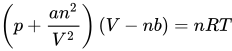
where:
- is the pressure,
- is the volume,
- is the number of moles,
- is the absolute temperature,
- is the molar gas constant; , with being the Avogadro constant and being the Boltzmann constant.
- and are constants that introduce the effects of attraction and volume respectively and depend on the substance in question.


Critical point[edit]
At the critical point one has , and , leading to
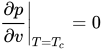
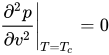


along with a critical point compressibility factor of
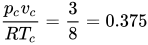
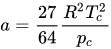
which then leads to

Virial form[edit]
One can re-write the van der Waals equation given above as a virial equation of state as follows:
- Failed to parse (SVG (MathML can be enabled via browser plugin): Invalid response ("Math extension cannot connect to Restbase.") from server "https://wikimedia.org/api/rest_v1/":): {\displaystyle Z := \frac{pV}{nRT} = \frac{1}{1- \frac{bn}{V}} - \frac{an}{RTV} }
Using the well known series expansion Failed to parse (SVG (MathML can be enabled via browser plugin): Invalid response ("Math extension cannot connect to Restbase.") from server "https://wikimedia.org/api/rest_v1/":): {\displaystyle (1-x)^{-1} = 1 + x + x^2 + x^3 + ...} one can write the first term of the right hand side as [3]:
- Failed to parse (SVG (MathML can be enabled via browser plugin): Invalid response ("Math extension cannot connect to Restbase.") from server "https://wikimedia.org/api/rest_v1/":): {\displaystyle \frac{1}{1- \frac{bn}{V}} = 1 + \frac{bn}{V} + \left( \frac{bn}{V} \right)^2 + \left( \frac{bn}{V} \right)^3 + ... }
Incorporating the second term of the right hand side in its due place leads to:
- Failed to parse (SVG (MathML can be enabled via browser plugin): Invalid response ("Math extension cannot connect to Restbase.") from server "https://wikimedia.org/api/rest_v1/":): {\displaystyle Z = 1 + \left( b -\frac{a}{RT} \right) \frac{n}{V} + \left( \frac{bn}{V} \right)^2 + \left( \frac{bn}{V} \right)^3 + ...} .
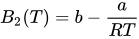
From the above one can see that the second virial coefficient corresponds to
and the third virial coefficient is given by
- Failed to parse (SVG (MathML can be enabled via browser plugin): Invalid response ("Math extension cannot connect to Restbase.") from server "https://wikimedia.org/api/rest_v1/":): {\displaystyle B_{3}(T)= b^2 }
Boyle temperature[edit]
The Boyle temperature of the van der Waals equation is given by
- Failed to parse (SVG (MathML can be enabled via browser plugin): Invalid response ("Math extension cannot connect to Restbase.") from server "https://wikimedia.org/api/rest_v1/":): {\displaystyle B_2\vert_{T=T_B}=0 = b -\frac{a}{RT_B} }
leading to
- Failed to parse (SVG (MathML can be enabled via browser plugin): Invalid response ("Math extension cannot connect to Restbase.") from server "https://wikimedia.org/api/rest_v1/":): {\displaystyle T_B = \frac{a}{bR}}
Dimensionless formulation[edit]
If one takes the following reduced quantities
- Failed to parse (SVG (MathML can be enabled via browser plugin): Invalid response ("Math extension cannot connect to Restbase.") from server "https://wikimedia.org/api/rest_v1/":): {\displaystyle \tilde{p} = \frac{p}{p_c};~ \tilde{V} = \frac{V}{V_c}; ~\tilde{t} = \frac{T}{T_c};}
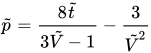
one arrives at
The following image is a plot of the isotherms Failed to parse (SVG (MathML can be enabled via browser plugin): Invalid response ("Math extension cannot connect to Restbase.") from server "https://wikimedia.org/api/rest_v1/":): {\displaystyle T/T_c} = 0.85, 0.90, 0.95, 1.0 and 1.05 (from bottom to top) for the van der Waals equation of state:

Critical exponents[edit]
The critical exponents of the Van der Waals equation of state place it in the mean field universality class.
See also[edit]
References[edit]
- ↑ J. D. van der Waals "Over de Continuiteit van den Gas- en Vloeistoftoestand", doctoral thesis, Leiden, A,W, Sijthoff (1873)
- ↑ English translation: J. D. van der Waals "On the Continuity of the Gaseous and Liquid States", Dover Publications ISBN: 0486495930
- ↑ This expansion is valid as long as Failed to parse (SVG (MathML can be enabled via browser plugin): Invalid response ("Math extension cannot connect to Restbase.") from server "https://wikimedia.org/api/rest_v1/":): {\displaystyle -1 < x < 1} , which is indeed the case for Failed to parse (SVG (MathML can be enabled via browser plugin): Invalid response ("Math extension cannot connect to Restbase.") from server "https://wikimedia.org/api/rest_v1/":): {\displaystyle bn/V}
Related reading
- Johannes Diderik van der Waals "The Equation of State for Gases and Liquids", Nobel Lecture, December 12, 1910
- Luis Gonzalez MacDowell and Peter Virnau "El integrante lazo de van der Waals", Anales de la Real Sociedad Española de Química 101 #1 pp. 19-30 (2005)