9-3 Lennard-Jones potential: Difference between revisions
Jump to navigation
Jump to search
m (Better defined r) |
Carl McBride (talk | contribs) m (Slight tidy + added a reference.) |
||
| Line 1: | Line 1: | ||
The '''9-3 Lennard-Jones potential''' is related to the [[Lennard-Jones model| Lennard-Jones potential]]. | |||
The 9-3 Lennard-Jones potential is related to the [[Lennard-Jones model| Lennard-Jones potential]]. | |||
It has the following form: | It has the following form: | ||
: <math> | : <math> | ||
\ | \Phi_{12}(r) = \frac{ 3 \sqrt{3}}{ 2} \epsilon \left[ \left( \frac{\sigma}{r} \right)^9 - | ||
\left( \frac{ \sigma }{r} \right)^3 \right]. | \left( \frac{ \sigma }{r} \right)^3 \right]. | ||
</math> | </math> | ||
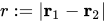
where <math>\ | where <math>\Phi_{12}(r)</math> is the [[intermolecular pair potential]] and <math>r := |\mathbf{r}_1 - \mathbf{r}_2|</math>. | ||
The minimum value of <math> \Phi(r) </math> is obtained at <math> r = r_{min} </math>, with | The minimum value of <math> \Phi(r) </math> is obtained at <math> r = r_{min} </math>, with | ||
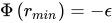
* <math> \Phi \left( r_{min} \right) = - \epsilon </math>, | * <math> \Phi \left( r_{min} \right) = - \epsilon </math>, | ||
* <math> \frac{ r_{min} }{\sigma} = 3^{1/6} </math> | * <math> \frac{ r_{min} }{\sigma} = 3^{1/6} </math> | ||
== Applications == | == Applications == | ||
It is commonly used to model the interaction between the particles | It is commonly used to model the interaction between the particles | ||
of a fluid with a flat structureless solid wall. | of a fluid with a flat structureless solid wall or ''vice versa'' (Ref. 1). | ||
== Interaction between a solid and a fluid molecule == | == Interaction between a solid and a fluid molecule == | ||
Let us consider the space divided in two regions: | Let us consider the space divided in two regions: | ||
| Line 56: | Line 54: | ||
- \frac{\sigma^3 }{ 2 x^3 } \right] | - \frac{\sigma^3 }{ 2 x^3 } \right] | ||
</math> | </math> | ||
==References== | |||
#[http://dx.doi.org/10.1063/1.435080 Farid F. Abraham and Y. Singh "The structure of a hard-sphere fluid in contact with a soft repulsive wall", Journal of Chemical Physics '''67''' pp. 2384-2385 (1977)] | |||
[[category:models]] | [[category:models]] | ||
Latest revision as of 15:44, 24 July 2008
The 9-3 Lennard-Jones potential is related to the Lennard-Jones potential. It has the following form:
![{\displaystyle \Phi _{12}(r)={\frac {3{\sqrt {3}}}{2}}\epsilon \left[\left({\frac {\sigma }{r}}\right)^{9}-\left({\frac {\sigma }{r}}\right)^{3}\right].}](https://wikimedia.org/api/rest_v1/media/math/render/svg/700c59d39a92fcf21d3593bfc52c46d759211bc7)
where is the intermolecular pair potential and . The minimum value of is obtained at , with



- ,

Applications[edit]
It is commonly used to model the interaction between the particles of a fluid with a flat structureless solid wall or vice versa (Ref. 1).
Interaction between a solid and a fluid molecule[edit]
Let us consider the space divided in two regions:
- : this region is occupied by a diffuse solid with density composed of 12-6 Lennard-Jones atoms


with parameters and


Our aim is to compute the total interaction between this solid and a molecule located at a position . Such an interaction can be computed using cylindrical coordinates.

The interaction will be:
![{\displaystyle \Phi _{W}\left(x\right)=4\epsilon _{sf}\rho _{s}\int _{0}^{2\pi }d\phi \int _{-\infty }^{-x}dz\int _{0}^{\infty }{\textrm {dr}}\left[\sigma ^{12}{\frac {r}{(r^{2}+z^{2})^{6}}}-\sigma ^{6}{\frac {r}{(r^{2}+z^{2})^{3}}}\right].}](https://wikimedia.org/api/rest_v1/media/math/render/svg/0bb80f2023adb9aaa5c9531cbd5aa88a08d01d15)
![{\displaystyle \Phi _{W}\left(x\right)=8\pi \epsilon _{sf}\rho _{s}\int _{-\infty }^{-x}{{\textrm {d}}z}\left[{\frac {\sigma ^{12}}{10(r^{2}+z^{2})^{5}}}-{\frac {\sigma ^{6}}{4(r^{2}+z^{2})^{2}}}\right]_{r=\infty }^{r=0}.}](https://wikimedia.org/api/rest_v1/media/math/render/svg/648021182c93409666d69c647ff50356664d24a4)
![{\displaystyle \Phi _{W}\left(x\right)=8\pi \epsilon _{sf}\rho _{s}\int _{-\infty }^{-x}{{\textrm {d}}z}\left[{\frac {\sigma ^{12}}{10z^{10}}}-{\frac {\sigma ^{6}}{4z^{4}}}\right];}](https://wikimedia.org/api/rest_v1/media/math/render/svg/b4859364dee3a48d3668fb5fa4ed83218bfd817a)
![{\displaystyle \Phi _{W}\left(x\right)=8\pi \epsilon _{sf}\rho _{s}\left[-{\frac {\sigma ^{12}}{90z^{9}}}+{\frac {\sigma ^{6}}{12z^{3}}}\right]_{z=-\infty }^{z=-x};}](https://wikimedia.org/api/rest_v1/media/math/render/svg/3bfe145b725f03951d6be57ea8b3d1df20f69f76)
![{\displaystyle \Phi _{W}\left(x\right)={\frac {4\pi \epsilon _{sf}\rho _{s}\sigma ^{3}}{3}}\left[{\frac {\sigma ^{9}}{15x^{9}}}-{\frac {\sigma ^{3}}{2x^{3}}}\right]}](https://wikimedia.org/api/rest_v1/media/math/render/svg/bca25e811981041a46db9df804c3c887cd553298)