Critical exponents: Difference between revisions
Carl McBride (talk | contribs) m (Added cleanup tag) |
|||
| (14 intermediate revisions by 2 users not shown) | |||
| Line 1: | Line 1: | ||
'''Critical exponents'''. Groups of critical exponents form [[universality classes]]. | |||
==Reduced distance: <math>\epsilon</math>== | |||
[[ | <math>\epsilon</math> is the reduced distance from the critical [[temperature]], i.e. | ||
:<math>\ | :<math>\epsilon = \left| 1 -\frac{T}{T_c}\right|</math> | ||
Note that this implies a certain symmetry when the [[Critical points|critical point]] is approached from either 'above' or 'below', which is not necessarily the case. | |||
==Heat capacity exponent: <math>\alpha</math>== | |||
The isochoric [[heat capacity]] is given by <math>C_v</math> | |||
:<math>\left. C_v\right.=C_0 \epsilon^{-\alpha}</math> | |||
Theoretically one has <math>\alpha = 0.1096(5)</math><ref name="Campostrini2002">[http://dx.doi.org/10.1103/PhysRevE.65.066127 Massimo Campostrini, Andrea Pelissetto, Paolo Rossi, and Ettore Vicari "25th-order high-temperature expansion results for three-dimensional Ising-like systems on the simple-cubic lattice", Physical Review E '''65''' 066127 (2002)]</ref> for the three dimensional [[Ising model]], and <math>\alpha = -0.0146(8)</math><ref name="Campostrini2001" >[http://dx.doi.org/10.1103/PhysRevB.63.214503 Massimo Campostrini, Martin Hasenbusch, Andrea Pelissetto, Paolo Rossi, and Ettore Vicari "Critical behavior of the three-dimensional XY universality class" Physical Review B '''63''' 214503 (2001)]</ref> for the three-dimensional XY [[Universality classes |universality class]]. | |||
Experimentally <math>\alpha = 0.1105^{+0.025}_{-0.027}</math><ref>[http://dx.doi.org/10.1103/PhysRevE.59.1795 A. Haupt and J. Straub "Evaluation of the isochoric heat capacity measurements at the critical isochore of SF6 performed during the German Spacelab Mission D-2", Physical Review E '''59''' pp. 1795-1802 (1999)]</ref>. | |||
==Magnetic order parameter exponent: <math>\beta</math>== | |||
The magnetic order parameter, <math>m</math> is given by | |||
:<math>\left. m\right. = m_0 \epsilon^\beta</math> | :<math>\left. m\right. = m_0 \epsilon^\beta</math> | ||
Theoretically one has <math>\beta =0.32653(10)</math><ref name="Campostrini2002"> </ref> for the [[Universality classes#Ising |three dimensional Ising model]], and <math>\beta = 0.3485(2)</math><ref name="Campostrini2001"> </ref> for the three-dimensional XY universality class. | |||
==Susceptibility exponent: <math>\gamma</math>== | |||
[[Susceptibility]] | [[Susceptibility]] | ||
:<math>\left. \chi \right. = \chi_0 \epsilon^{-\gamma}</math> | :<math>\left. \chi \right. = \chi_0 \epsilon^{-\gamma}</math> | ||
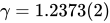
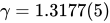
Correlation length | Theoretically one has <math>\gamma = 1.2373(2)</math><ref name="Campostrini2002"> </ref> for the [[Universality classes#Ising |three dimensional Ising model]], and <math>\gamma = 1.3177(5)</math><ref name="Campostrini2001"> </ref> for the three-dimensional XY universality class. | ||
==Correlation length== | |||
:<math>\left. \xi \right.= \xi_0 \epsilon^{-\nu}</math> | :<math>\left. \xi \right.= \xi_0 \epsilon^{-\nu}</math> | ||
Theoretically one has <math>\nu = 0.63012(16)</math><ref name="Campostrini2002"> </ref> for the [[Universality classes#Ising |three dimensional Ising model]], and <math>\nu = 0.67155(27)</math><ref name="Campostrini2001"> </ref> for the three-dimensional XY universality class. | |||
==Inequalities== | |||
====Fisher inequality==== | |||
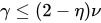
The Fisher inequality (Eq. 5 <ref>[http://dx.doi.org/10.1103/PhysRev.180.594 Michael E. Fisher "Rigorous Inequalities for Critical-Point Correlation Exponents", Physical Review '''180''' pp. 594-600 (1969)]</ref>) | |||
:<math>\ | :<math>\gamma \le (2-\eta) \nu</math> | ||
====Griffiths inequality==== | |||
The Griffiths inequality (Eq. 3 <ref>[http://dx.doi.org/10.1103/PhysRevLett.14.623 Robert B. Griffiths "Thermodynamic Inequality Near the Critical Point for Ferromagnets and Fluids", Physical Review Letters '''14''' 623-624 (1965)]</ref>): | |||
:<math>(1+\delta)\beta \ge 2-\alpha'</math> | |||
====Josephson inequality==== | |||
The Josephson inequality <ref>[http://dx.doi.org/10.1088/0370-1328/92/2/301 B. D. Josephson "Inequality for the specific heat: I. Derivation", Proceedings of the Physical Society '''92''' pp. 269-275 (1967)]</ref><ref>[http://dx.doi.org/10.1088/0370-1328/92/2/302 B. D. Josephson "Inequality for the specific heat: II. Application to critical phenomena", Proceedings of the Physical Society '''92''' pp. 276-284 (1967)]</ref><ref>[http://dx.doi.org/10.1007/BF01008478 Alan D. Sokal "Rigorous proof of the high-temperature Josephson inequality for critical exponents", Journal of Statistical Physics '''25''' pp. 51-56 (1981)]</ref> | |||
:<math>d\nu \ge 2-\alpha</math> | |||
====Liberman inequality==== | |||
<ref>[http://dx.doi.org/10.1063/1.1726488 David A. Liberman "Another Relation Between Thermodynamic Functions Near the Critical Point of a Simple Fluid", Journal of Chemical Physics '''44''' 419-420 (1966)]</ref> | |||
====Rushbrooke inequality==== | |||
The Rushbrooke inequality (Eq. 2 <ref>[http://dx.doi.org/10.1063/1.1734338 G. S. Rushbrooke "On the Thermodynamics of the Critical Region for the Ising Problem", Journal of Chemical Physics 39, 842-843 (1963)]</ref>), based on the work of Essam and Fisher (Eq. 38 <ref>[http://dx.doi.org/10.1063/1.1733766 John W. Essam and Michael E. Fisher "Padé Approximant Studies of the Lattice Gas and Ising Ferromagnet below the Critical Point", Journal of Chemical Physics 38, 802-812 (1963)]</ref>) is given by | |||
:<math>\alpha' + 2\beta + \gamma' \ge 2</math>. | |||
Using the above-mentioned values<ref name="Campostrini2002"> </ref> one has: | |||
:<math>0.1096 + (2\times0.32653) + 1.2373 = 1.99996</math> | |||
====Widom inequality==== | |||
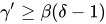
The Widom inequality <ref>[http://dx.doi.org/10.1063/1.1726135 B. Widom "Degree of the Critical Isotherm", Journal of Chemical Physics '''41''' pp. 1633-1634 (1964)]</ref> | |||
:<math>\ | :<math>\gamma' \ge \beta(\delta -1)</math> | ||
====Gamma divergence | ==Hyperscaling== | ||
==Gamma divergence== | |||
When approaching the critical point along the critical isochore (<math>T > T_c</math>) the divergence is of the form | When approaching the critical point along the critical isochore (<math>T > T_c</math>) the divergence is of the form | ||
:<math>\left. \right. | :<math>\left. \right. \kappa_T \sim (T-T_c)^{-\gamma} \sim (p-p_c)^{-\gamma}</math> | ||
where <math>\gamma</math> is 1.0 for the [[Van der Waals equation of state]], and is usually 1.2 to 1.3. | where <math>\kappa_T</math> is the [[Compressibility#Isothermal compressibility | isothermal compressibility]]. <math>\gamma</math> is 1.0 for the [[Van der Waals equation of state#Critical exponents | Van der Waals equation of state]], and is usually 1.2 to 1.3. | ||
==Epsilon divergence== | |||
When approaching the critical point along the critical isotherm the divergence is of the form | When approaching the critical point along the critical isotherm the divergence is of the form | ||
Latest revision as of 18:49, 17 February 2013
Critical exponents. Groups of critical exponents form universality classes.
Reduced distance: [edit]

is the reduced distance from the critical temperature, i.e.
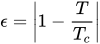
Note that this implies a certain symmetry when the critical point is approached from either 'above' or 'below', which is not necessarily the case.
Heat capacity exponent: [edit]

The isochoric heat capacity is given by


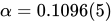
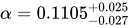
Theoretically one has [1] for the three dimensional Ising model, and [2] for the three-dimensional XY universality class. Experimentally [3].

Magnetic order parameter exponent: [edit]

The magnetic order parameter, is given by


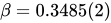
Theoretically one has [1] for the three dimensional Ising model, and [2] for the three-dimensional XY universality class.

Susceptibility exponent: [edit]


Theoretically one has [1] for the three dimensional Ising model, and [2] for the three-dimensional XY universality class.
Correlation length[edit]

Theoretically one has [1] for the three dimensional Ising model, and [2] for the three-dimensional XY universality class.


Inequalities[edit]
Fisher inequality[edit]
The Fisher inequality (Eq. 5 [4])
Griffiths inequality[edit]
The Griffiths inequality (Eq. 3 [5]):

Josephson inequality[edit]
The Josephson inequality [6][7][8]

Liberman inequality[edit]
Rushbrooke inequality[edit]
The Rushbrooke inequality (Eq. 2 [10]), based on the work of Essam and Fisher (Eq. 38 [11]) is given by
- .

Using the above-mentioned values[1] one has:

Widom inequality[edit]
The Widom inequality [12]
Hyperscaling[edit]
Gamma divergence[edit]
When approaching the critical point along the critical isochore () the divergence is of the form


where is the isothermal compressibility. is 1.0 for the Van der Waals equation of state, and is usually 1.2 to 1.3.

Epsilon divergence[edit]
When approaching the critical point along the critical isotherm the divergence is of the form

where is 2/3 for the Van der Waals equation of state, and is usually 0.75 to 0.8.
References[edit]
- ↑ 1.0 1.1 1.2 1.3 1.4 Massimo Campostrini, Andrea Pelissetto, Paolo Rossi, and Ettore Vicari "25th-order high-temperature expansion results for three-dimensional Ising-like systems on the simple-cubic lattice", Physical Review E 65 066127 (2002)
- ↑ 2.0 2.1 2.2 2.3 Massimo Campostrini, Martin Hasenbusch, Andrea Pelissetto, Paolo Rossi, and Ettore Vicari "Critical behavior of the three-dimensional XY universality class" Physical Review B 63 214503 (2001)
- ↑ A. Haupt and J. Straub "Evaluation of the isochoric heat capacity measurements at the critical isochore of SF6 performed during the German Spacelab Mission D-2", Physical Review E 59 pp. 1795-1802 (1999)
- ↑ Michael E. Fisher "Rigorous Inequalities for Critical-Point Correlation Exponents", Physical Review 180 pp. 594-600 (1969)
- ↑ Robert B. Griffiths "Thermodynamic Inequality Near the Critical Point for Ferromagnets and Fluids", Physical Review Letters 14 623-624 (1965)
- ↑ B. D. Josephson "Inequality for the specific heat: I. Derivation", Proceedings of the Physical Society 92 pp. 269-275 (1967)
- ↑ B. D. Josephson "Inequality for the specific heat: II. Application to critical phenomena", Proceedings of the Physical Society 92 pp. 276-284 (1967)
- ↑ Alan D. Sokal "Rigorous proof of the high-temperature Josephson inequality for critical exponents", Journal of Statistical Physics 25 pp. 51-56 (1981)
- ↑ David A. Liberman "Another Relation Between Thermodynamic Functions Near the Critical Point of a Simple Fluid", Journal of Chemical Physics 44 419-420 (1966)
- ↑ G. S. Rushbrooke "On the Thermodynamics of the Critical Region for the Ising Problem", Journal of Chemical Physics 39, 842-843 (1963)
- ↑ John W. Essam and Michael E. Fisher "Padé Approximant Studies of the Lattice Gas and Ising Ferromagnet below the Critical Point", Journal of Chemical Physics 38, 802-812 (1963)
- ↑ B. Widom "Degree of the Critical Isotherm", Journal of Chemical Physics 41 pp. 1633-1634 (1964)