9-6 Lennard-Jones potential: Difference between revisions
Jump to navigation
Jump to search
Carl McBride (talk | contribs) (New page: The '''9-6 Lennard-Jones potential''' (also known as the 6-9 potential) is a variant the more well known Lennard-Jones model. It is used for computing non-bonded interactions. The pote...) |
Carl McBride (talk | contribs) (Added Eq in terms of sigma) |
||
| (One intermediate revision by the same user not shown) | |||
| Line 1: | Line 1: | ||
The '''9-6 Lennard-Jones potential''' (also known as the 6-9 potential) is a variant the more well known [[Lennard-Jones model]]. It is used for computing non-bonded interactions. The potential is given by <ref>[http://dx.doi.org/10.1063/1.1674031 Arieh Warshel and Shneior Lifson "Consistent Force Field Calculations. II. Crystal Structures, Sublimation Energies, Molecular and Lattice Vibrations, Molecular Conformations, and Enthalpies of Alkanes", Journal of Chemical Physics '''53''' pp. 582-594 (1970)]</ref> : | The '''9-6 Lennard-Jones potential''' (also known as the 6-9 potential) is a variant the more well known [[Lennard-Jones model]]. It is used for computing non-bonded interactions. The potential is given by <ref>[http://dx.doi.org/10.1063/1.1674031 Arieh Warshel and Shneior Lifson "Consistent Force Field Calculations. II. Crystal Structures, Sublimation Energies, Molecular and Lattice Vibrations, Molecular Conformations, and Enthalpies of Alkanes", Journal of Chemical Physics '''53''' pp. 582-594 (1970)]</ref> : | ||
:<math> \Phi_{12}(r) = \epsilon \left[ 2\left(\frac{\sigma}{r} \right)^{9} - | :<math> \Phi_{12}(r) = \epsilon \left[ 2\left(\frac{r_m}{r} \right)^{9} - 3\left( \frac{r_m}{r}\right)^6 \right] </math> | ||
or in terms of <math> \sigma </math> (the value of <math>r</math> at which <math> \Phi_{12}(r)=0</math>) one has: | |||
:<math> \Phi_{12}(r) = 6.75 \epsilon \left[ \left(\frac{\sigma}{r} \right)^{9} - \left( \frac{\sigma}{r}\right)^6 \right] </math> | |||
where | where | ||
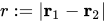
* <math>r := |\mathbf{r}_1 - \mathbf{r}_2|</math> | * <math>r := |\mathbf{r}_1 - \mathbf{r}_2|</math> | ||
* <math> \Phi_{12}(r) </math> is the [[intermolecular pair potential]] between two particles or ''sites'' | * <math> \Phi_{12}(r) </math> is the [[intermolecular pair potential]] between two particles or ''sites'' | ||
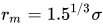
* <math> | * <math> r_m </math> is the distance, <math>r</math>, at which <math> \Phi_{12}(r)</math> is a minimum, which corresponds to <math> r_m = 1.5^{1/3} \sigma</math>. | ||
* <math> \epsilon </math> is the well depth (energy) | * <math> \epsilon </math> is the well depth (energy) | ||
Latest revision as of 14:41, 4 February 2014
The 9-6 Lennard-Jones potential (also known as the 6-9 potential) is a variant the more well known Lennard-Jones model. It is used for computing non-bonded interactions. The potential is given by [1] :
![{\displaystyle \Phi _{12}(r)=\epsilon \left[2\left({\frac {r_{m}}{r}}\right)^{9}-3\left({\frac {r_{m}}{r}}\right)^{6}\right]}](https://wikimedia.org/api/rest_v1/media/math/render/svg/f4586c45272c1fe20c892c60666876adafd20a56)
or in terms of (the value of at which ) one has:


![{\displaystyle \Phi _{12}(r)=6.75\epsilon \left[\left({\frac {\sigma }{r}}\right)^{9}-\left({\frac {\sigma }{r}}\right)^{6}\right]}](https://wikimedia.org/api/rest_v1/media/math/render/svg/e9d83ef20764b855b3e43bd4fdb536943c90af3e)
where
- is the intermolecular pair potential between two particles or sites
- is the distance, , at which is a minimum, which corresponds to .
- is the well depth (energy)



It is worth noting that the inclusion of an odd power (here the 9) adds an additional computational overhead, and the 8-6 Lennard-Jones potential has been suggested as a viable alternative.