Chemical potential: Difference between revisions
No edit summary |
Carl McBride (talk | contribs) m (Reverted edits by 70.135.118.126 (talk) to last revision by Nice and Tidy) |
||
| Line 42: | Line 42: | ||
[[category:classical thermodynamics]] | [[category:classical thermodynamics]] | ||
[[category:statistical mechanics]] | [[category:statistical mechanics]] | ||
Revision as of 16:32, 4 January 2012
Classical thermodynamics
Definition:
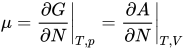
where is the Gibbs energy function, leading to

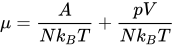
where is the Helmholtz energy function, is the Boltzmann constant, is the pressure, is the temperature and is the volume.


Statistical mechanics
The chemical potential is the derivative of the Helmholtz energy function with respect to the number of particles

where Failed to parse (SVG (MathML can be enabled via browser plugin): Invalid response ("Math extension cannot connect to Restbase.") from server "https://wikimedia.org/api/rest_v1/":): {\displaystyle Z_N} is the partition function for a fluid of Failed to parse (SVG (MathML can be enabled via browser plugin): Invalid response ("Math extension cannot connect to Restbase.") from server "https://wikimedia.org/api/rest_v1/":): {\displaystyle N} identical particles
- Failed to parse (SVG (MathML can be enabled via browser plugin): Invalid response ("Math extension cannot connect to Restbase.") from server "https://wikimedia.org/api/rest_v1/":): {\displaystyle Z_N= \left( \frac{2\pi m k_BT}{h^2} \right)^{3N/2} Q_N}
and Failed to parse (SVG (MathML can be enabled via browser plugin): Invalid response ("Math extension cannot connect to Restbase.") from server "https://wikimedia.org/api/rest_v1/":): {\displaystyle Q_N} is the configurational integral
- Failed to parse (SVG (MathML can be enabled via browser plugin): Invalid response ("Math extension cannot connect to Restbase.") from server "https://wikimedia.org/api/rest_v1/":): {\displaystyle Q_N = \frac{1}{N!} \int ... \int \exp (-U_N/k_B T) dr_1...dr_N}
Kirkwood charging formula
The Kirkwood charging formula is given by [1]

where Failed to parse (SVG (MathML can be enabled via browser plugin): Invalid response ("Math extension cannot connect to Restbase.") from server "https://wikimedia.org/api/rest_v1/":): {\displaystyle \Phi_{12}(r)} is the intermolecular pair potential and Failed to parse (SVG (MathML can be enabled via browser plugin): Invalid response ("Math extension cannot connect to Restbase.") from server "https://wikimedia.org/api/rest_v1/":): {\displaystyle {\rm g}(r)} is the pair correlation function.
See also
References
Related reading