Uhlenbeck-Ford model: Difference between revisions
No edit summary |
No edit summary |
||
| Line 1: | Line 1: | ||
The '''Uhlenbeck-Ford model''' (UFM) was originally proposed by G. Uhlenbeck and G. Ford <ref>[G. Uhlenbeck and G. Ford, in Studies in Statistical Mechanics— The Theory of Linear Graphs with Application to the Theory of the Virial Development of the Properties of Gases, edited by G. E. Uhlenbeck and J. de Boer (North-Holland, Amsterdam, 1962), Vol. 2.] </ref> for the theoretical study of imperfect gases. This model is characterized by an ultrasoft, purely repulsive pairwise interaction potential that diverges logarithmically at the origin and features an energy scale that coincides with the thermal energy unit <math>k_B T</math> where <math>k_B</math> is the Boltzmman constant and <math>T</math> the absolute temperature. The particular functional form of the potential permits, in principle, that the virial coeffcients and, therefore, the equation of state and excess free energies for the fluid phase be evaluated analytically. | The '''Uhlenbeck-Ford model''' (UFM) was originally proposed by G. Uhlenbeck and G. Ford <ref>[G. Uhlenbeck and G. Ford, in Studies in Statistical Mechanics— The Theory of Linear Graphs with Application to the Theory of the Virial Development of the Properties of Gases, edited by G. E. Uhlenbeck and J. de Boer (North-Holland, Amsterdam, 1962), Vol. 2.] </ref> for the theoretical study of imperfect gases. This model is characterized by an ultrasoft, purely repulsive pairwise interaction potential that diverges logarithmically at the origin and features an energy scale that coincides with the thermal energy unit <math>k_B T</math> where <math>k_B</math> is the Boltzmman constant and <math>T</math> the absolute temperature. The particular functional form of the potential permits, in principle, that the virial coeffcients and, therefore, the equation of state and excess free energies for the fluid phase be evaluated analytically. | ||
| Line 8: | Line 6: | ||
:<math>U_{UF}(r) = - \frac{p}{\beta} \ln \left(1-e^{-(r/\sigma)^2} \right)</math> | :<math>U_{UF}(r) = - \frac{p}{\beta} \ln \left(1-e^{-(r/\sigma)^2} \right)</math> | ||
where | where | ||
| Line 17: | Line 13: | ||
* <math> \sigma </math> is a length-scale parameter. | * <math> \sigma </math> is a length-scale parameter. | ||
== Functional form == | |||
The UFM's equation of state has recently been studied by Paula Leite, Freitas, Azevedo and de Koning <ref>[http://dx.doi.org/10.1063/1.4967775 R. Paula Leite, R. Freitas, R. Azevedo and M. de Koning "The Uhlenbeck-Ford model: Exact virial coefficients and application as a reference system in fluid-phase free-energy calculations", Journal of Chemical Physics '''145''', 194101 (2016)]</ref>. This EOS can be expressed in terms of virial coefficients in a virial expansion, given by | |||
:<math>\beta bP = x + \sum_{n=2}^{\infty} \tilde{B}_n \,x^n</math> | |||
==References== | ==References== | ||
Revision as of 01:07, 12 October 2017
The Uhlenbeck-Ford model (UFM) was originally proposed by G. Uhlenbeck and G. Ford [1] for the theoretical study of imperfect gases. This model is characterized by an ultrasoft, purely repulsive pairwise interaction potential that diverges logarithmically at the origin and features an energy scale that coincides with the thermal energy unit where is the Boltzmman constant and Failed to parse (SVG (MathML can be enabled via browser plugin): Invalid response ("Math extension cannot connect to Restbase.") from server "https://wikimedia.org/api/rest_v1/":): {\displaystyle T} the absolute temperature. The particular functional form of the potential permits, in principle, that the virial coeffcients and, therefore, the equation of state and excess free energies for the fluid phase be evaluated analytically.


Functional form
The Uhlenbeck-Ford model is given by :
- Failed to parse (SVG (MathML can be enabled via browser plugin): Invalid response ("Math extension cannot connect to Restbase.") from server "https://wikimedia.org/api/rest_v1/":): {\displaystyle U_{UF}(r) = - \frac{p}{\beta} \ln \left(1-e^{-(r/\sigma)^2} \right)}
where
- Failed to parse (SVG (MathML can be enabled via browser plugin): Invalid response ("Math extension cannot connect to Restbase.") from server "https://wikimedia.org/api/rest_v1/":): {\displaystyle p > 0 } is a scaling factor;
- Failed to parse (SVG (MathML can be enabled via browser plugin): Invalid response ("Math extension cannot connect to Restbase.") from server "https://wikimedia.org/api/rest_v1/":): {\displaystyle \beta \equiv (k_B T)^{-1} } is the well depth (energy);
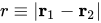
- is the interparticle distance;
- Failed to parse (SVG (MathML can be enabled via browser plugin): Invalid response ("Math extension cannot connect to Restbase.") from server "https://wikimedia.org/api/rest_v1/":): {\displaystyle \sigma } is a length-scale parameter.
Functional form
The UFM's equation of state has recently been studied by Paula Leite, Freitas, Azevedo and de Koning [2]. This EOS can be expressed in terms of virial coefficients in a virial expansion, given by
- Failed to parse (SVG (MathML can be enabled via browser plugin): Invalid response ("Math extension cannot connect to Restbase.") from server "https://wikimedia.org/api/rest_v1/":): {\displaystyle \beta bP = x + \sum_{n=2}^{\infty} \tilde{B}_n \,x^n}
References
- ↑ [G. Uhlenbeck and G. Ford, in Studies in Statistical Mechanics— The Theory of Linear Graphs with Application to the Theory of the Virial Development of the Properties of Gases, edited by G. E. Uhlenbeck and J. de Boer (North-Holland, Amsterdam, 1962), Vol. 2.]
- ↑ R. Paula Leite, R. Freitas, R. Azevedo and M. de Koning "The Uhlenbeck-Ford model: Exact virial coefficients and application as a reference system in fluid-phase free-energy calculations", Journal of Chemical Physics 145, 194101 (2016)
- Related reading
- R. Paula Leite, R. Freitas, R. Azevedo and M. de Koning "The Uhlenbeck-Ford model: Exact virial coefficients and application as a reference system in fluid-phase free-energy calculations", Journal of Chemical Physics 145, 194101 (2016)
- R. Paula Leite, R. Freitas, R. Azevedo and M. de Koning "Supplemental Material: The Uhlenbeck-Ford model: Exact virial coefficients and application as a reference system in fluid-phase free-energy calculations", Journal of Chemical Physics 145, 194101 (2016)
- R. Paula Leite, P. A. Santos-Flórez and M. de Koning "Uhlenbeck-Ford model: Phase diagram and corresponding-states analysis", Physical Review E 96, 032115 (2017)

|
This page contains numerical values and/or equations. If you intend to use ANY of the numbers or equations found in SklogWiki in any way, you MUST take them from the original published article or book, and cite the relevant source accordingly. |