Virial coefficients of model systems: Difference between revisions
Jump to navigation
Jump to search
mNo edit summary |
m (→Systems) |
||
| Line 20: | Line 20: | ||
== Systems == | == Systems == | ||
*[[ | *[[hard sphere: virial equation of state|Hard spheres]] | ||
*[[ | *[[hsrd sphere: virial equation of state|Hard disks]] | ||
Revision as of 16:37, 22 February 2007
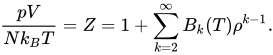
The virial equation of state is used to describe the behavior of diluted gases. It is usually written as an expansion of the compresiblity factor, , in terms of either the density or the pressure. In the first case:
where
- is the pressure
- Failed to parse (SVG (MathML can be enabled via browser plugin): Invalid response ("Math extension cannot connect to Restbase.") from server "https://wikimedia.org/api/rest_v1/":): {\displaystyle V } is the volume
- Failed to parse (SVG (MathML can be enabled via browser plugin): Invalid response ("Math extension cannot connect to Restbase.") from server "https://wikimedia.org/api/rest_v1/":): {\displaystyle N } is the number of molecules
- Failed to parse (SVG (MathML can be enabled via browser plugin): Invalid response ("Math extension cannot connect to Restbase.") from server "https://wikimedia.org/api/rest_v1/":): {\displaystyle \rho \equiv \frac{N}{V} } is the (number) density
- Failed to parse (SVG (MathML can be enabled via browser plugin): Invalid response ("Math extension cannot connect to Restbase.") from server "https://wikimedia.org/api/rest_v1/":): {\displaystyle B_k } is called the k-th virial coefficient