Grand canonical Monte Carlo: Difference between revisions
m (→Introduction) |
mNo edit summary |
||
| Line 1: | Line 1: | ||
'''Grand-canonical ensemble Monte Carlo''' (GCEMC) is a very versatile and powerful [[Monte Carlo]] technique that explicitly accounts for density fluctuations at fixed volume and [[temperature]]. This is achieved by means of trial insertion and deletion of molecules. Although this feature has made it the preferred choice for the study of [[Interface |interfacial]] phenomena, in the last decade | '''Grand-canonical ensemble Monte Carlo''' (GCEMC) is a very versatile and powerful [[Monte Carlo]] technique that explicitly accounts for density fluctuations at fixed volume and [[temperature]]. This is achieved by means of trial insertion and deletion of molecules. Although this feature has made it the preferred choice for the study of [[Interface |interfacial]] phenomena, in the last decade | ||
[[grand canonical ensemble | grand-canonical ensemble]] simulations have also found widespread applications in the study of bulk properties. Such applications had been hitherto limited by the very low particle insertion and deletion probabilities, but the development of the [[Configurational bias Monte Carlo |configurational bias]] grand canonical technique has very much improved the situation. | [[grand canonical ensemble | grand-canonical ensemble]] simulations have also found widespread applications in the study of bulk properties. Such applications had been hitherto limited by the very low particle insertion and deletion probabilities, but the development of the [[Configurational bias Monte Carlo |configurational bias]] grand canonical technique has very much improved the situation. | ||
Revision as of 12:17, 28 January 2008
Grand-canonical ensemble Monte Carlo (GCEMC) is a very versatile and powerful Monte Carlo technique that explicitly accounts for density fluctuations at fixed volume and temperature. This is achieved by means of trial insertion and deletion of molecules. Although this feature has made it the preferred choice for the study of interfacial phenomena, in the last decade grand-canonical ensemble simulations have also found widespread applications in the study of bulk properties. Such applications had been hitherto limited by the very low particle insertion and deletion probabilities, but the development of the configurational bias grand canonical technique has very much improved the situation.
Theoretical basis
In the grand canonical ensemble, one first chooses randomly whether a trial particle insertion or deletion is attempted. If insertion is chosen, a particle is placed with uniform probability density inside the system. If deletion is chosen, then one deletes one out of particles randomly. The trial move is then accepted or rejected according to the usual Monte Carlo lottery. As usual, a trial move from state Failed to parse (SVG (MathML can be enabled via browser plugin): Invalid response ("Math extension cannot connect to Restbase.") from server "https://wikimedia.org/api/rest_v1/":): {\displaystyle o} to state Failed to parse (SVG (MathML can be enabled via browser plugin): Invalid response ("Math extension cannot connect to Restbase.") from server "https://wikimedia.org/api/rest_v1/":): {\displaystyle n} is accepted with probability

- Failed to parse (SVG (MathML can be enabled via browser plugin): Invalid response ("Math extension cannot connect to Restbase.") from server "https://wikimedia.org/api/rest_v1/":): {\displaystyle acc(o \rightarrow n) = min \left (1, q \right ) }
where Failed to parse (SVG (MathML can be enabled via browser plugin): Invalid response ("Math extension cannot connect to Restbase.") from server "https://wikimedia.org/api/rest_v1/":): {\displaystyle q} is given by:
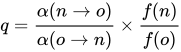
Here, Failed to parse (SVG (MathML can be enabled via browser plugin): Invalid response ("Math extension cannot connect to Restbase.") from server "https://wikimedia.org/api/rest_v1/":): {\displaystyle \alpha(o \rightarrow n) } is the probability density of attempting trial move from state Failed to parse (SVG (MathML can be enabled via browser plugin): Invalid response ("Math extension cannot connect to Restbase.") from server "https://wikimedia.org/api/rest_v1/":): {\displaystyle o} to state Failed to parse (SVG (MathML can be enabled via browser plugin): Invalid response ("Math extension cannot connect to Restbase.") from server "https://wikimedia.org/api/rest_v1/":): {\displaystyle n} (also known as underlying probability), while Failed to parse (SVG (MathML can be enabled via browser plugin): Invalid response ("Math extension cannot connect to Restbase.") from server "https://wikimedia.org/api/rest_v1/":): {\displaystyle f(o)} is the probability density of state .

As noted by Filinov, evaluation of the proper acceptance rules requires very carefull interpretation of the (clasical) grand canonical probability density:
- Failed to parse (SVG (MathML can be enabled via browser plugin): Invalid response ("Math extension cannot connect to Restbase.") from server "https://wikimedia.org/api/rest_v1/":): {\displaystyle f_L({\mathbf r}_1,{\mathbf r}_2 ..., {\mathbf r}_N) \propto \frac{\Lambda^{-3N}}{N!} e^{\beta \mu N} e^{-\beta U_N}}
where Failed to parse (SVG (MathML can be enabled via browser plugin): Invalid response ("Math extension cannot connect to Restbase.") from server "https://wikimedia.org/api/rest_v1/":): {\displaystyle N} is the total number of particles, Failed to parse (SVG (MathML can be enabled via browser plugin): Invalid response ("Math extension cannot connect to Restbase.") from server "https://wikimedia.org/api/rest_v1/":): {\displaystyle \mu} is the chemical potential, Failed to parse (SVG (MathML can be enabled via browser plugin): Invalid response ("Math extension cannot connect to Restbase.") from server "https://wikimedia.org/api/rest_v1/":): {\displaystyle \beta := 1/k_B T} and is the de De Broglie thermal wavelength.

The sub-index L makes emphasis on a particular definition of microstate in which particles are assumed to be distinguishable. Thus, Failed to parse (SVG (MathML can be enabled via browser plugin): Invalid response ("Math extension cannot connect to Restbase.") from server "https://wikimedia.org/api/rest_v1/":): {\displaystyle f_L } should be interpreted as the probability density of a classical state with labelled particles, having labelled particle 1 in position Failed to parse (SVG (MathML can be enabled via browser plugin): Invalid response ("Math extension cannot connect to Restbase.") from server "https://wikimedia.org/api/rest_v1/":): {\displaystyle {\mathbf r}_1} , labelled particle 2 in position Failed to parse (SVG (MathML can be enabled via browser plugin): Invalid response ("Math extension cannot connect to Restbase.") from server "https://wikimedia.org/api/rest_v1/":): {\displaystyle {\mathbf r}_2} and so on. Since labelling of the particles has no physical significance whatsoever, there are Failed to parse (SVG (MathML can be enabled via browser plugin): Invalid response ("Math extension cannot connect to Restbase.") from server "https://wikimedia.org/api/rest_v1/":): {\displaystyle N!} identical states which result from permutation of the labels (this explains the Failed to parse (SVG (MathML can be enabled via browser plugin): Invalid response ("Math extension cannot connect to Restbase.") from server "https://wikimedia.org/api/rest_v1/":): {\displaystyle N!} term in the denominator). Hence, the probability of the significant microstate of undistinguishable particles, i.e., one with Failed to parse (SVG (MathML can be enabled via browser plugin): Invalid response ("Math extension cannot connect to Restbase.") from server "https://wikimedia.org/api/rest_v1/":): {\displaystyle N} particles at positions Failed to parse (SVG (MathML can be enabled via browser plugin): Invalid response ("Math extension cannot connect to Restbase.") from server "https://wikimedia.org/api/rest_v1/":): {\displaystyle {\mathbf r}_1} , Failed to parse (SVG (MathML can be enabled via browser plugin): Invalid response ("Math extension cannot connect to Restbase.") from server "https://wikimedia.org/api/rest_v1/":): {\displaystyle {\mathbf r}_2} , etc., irrespective of the labels, will be given by:
- Failed to parse (SVG (MathML can be enabled via browser plugin): Invalid response ("Math extension cannot connect to Restbase.") from server "https://wikimedia.org/api/rest_v1/":): {\displaystyle f_U( \{{\mathbf r}_1,{\mathbf r}_2 ..., {\mathbf r}_N \} ) \propto \sum_P f({\mathbf r}_1,{\mathbf r}_2 ..., {\mathbf r}_N) = \Lambda^{-3N} e^{\beta \mu N} e^{-\beta U_N}}
where the Failed to parse (SVG (MathML can be enabled via browser plugin): Invalid response ("Math extension cannot connect to Restbase.") from server "https://wikimedia.org/api/rest_v1/":): {\displaystyle U} subindex stands for unlabelled, the coordinates in parentheis indicate that the positions are not atributted to any particular choice of labelling and the sum runs over all posible particle label permutations.
Upon trial insertion of an extra particle, one obtains:
- Failed to parse (Conversion error. Server ("https://wikimedia.org/api/rest_") reported: "Cannot get mml. Server problem."): {\displaystyle {\frac {f_{U}(N+1)}{f_{U}(N)}}=\Lambda ^{-3}e^{\beta \mu }e^{-\beta (U_{N+1}-U_{N})}}
The probability density of attempting an insertion is Failed to parse (SVG (MathML can be enabled via browser plugin): Invalid response ("Math extension cannot connect to Restbase.") from server "https://wikimedia.org/api/rest_v1/":): {\displaystyle \alpha( N \rightarrow N+1 ) = \frac{1}{2} \frac{1}{V} } . The Failed to parse (SVG (MathML can be enabled via browser plugin): Invalid response ("Math extension cannot connect to Restbase.") from server "https://wikimedia.org/api/rest_v1/":): {\displaystyle 1/2 } factor accounts for the probability of attempting an insertion (from the choice of insertion or deletion). The Failed to parse (SVG (MathML can be enabled via browser plugin): Invalid response ("Math extension cannot connect to Restbase.") from server "https://wikimedia.org/api/rest_v1/":): {\displaystyle 1/V} factor results from placing the particle with uniform probability anywhere inside the simulation box. The reverse attempt (moving from state of Failed to parse (SVG (MathML can be enabled via browser plugin): Invalid response ("Math extension cannot connect to Restbase.") from server "https://wikimedia.org/api/rest_v1/":): {\displaystyle N+1} particles to the original particle state) is chosen with probability:
- Failed to parse (SVG (MathML can be enabled via browser plugin): Invalid response ("Math extension cannot connect to Restbase.") from server "https://wikimedia.org/api/rest_v1/":): {\displaystyle \alpha( N+1 \rightarrow N ) = \frac{1}{2} \frac{1}{N+1} }
where the Failed to parse (SVG (MathML can be enabled via browser plugin): Invalid response ("Math extension cannot connect to Restbase.") from server "https://wikimedia.org/api/rest_v1/":): {\displaystyle 1/(N+1) } factor results from random removal of one among Failed to parse (SVG (MathML can be enabled via browser plugin): Invalid response ("Math extension cannot connect to Restbase.") from server "https://wikimedia.org/api/rest_v1/":): {\displaystyle N+1} particles. Therefore, the ratio of underlying probabilities is:
- Failed to parse (SVG (MathML can be enabled via browser plugin): Invalid response ("Math extension cannot connect to Restbase.") from server "https://wikimedia.org/api/rest_v1/":): {\displaystyle \frac{\alpha(n\rightarrow o)}{\alpha(o\rightarrow n)} = \frac{\alpha( N \rightarrow N+1 )}{\alpha( N+1 \rightarrow N)} = \frac{V}{N+1} }
Substitution of Eq.\ref{eq:alpharatio} and Eq.\ref{eq:fratio} into Eq.\ref{eq:q} yields the acceptance probability for attempted insertions:
- Failed to parse (SVG (MathML can be enabled via browser plugin): Invalid response ("Math extension cannot connect to Restbase.") from server "https://wikimedia.org/api/rest_v1/":): {\displaystyle acc(N \rightarrow N+1) = \frac{V \Lambda^{-3} }{N+1} e^{\beta \mu } e^{-\beta ( U_{N+1} - U_N )} }
For the inverse deletion process, similar arguments yield:
- Failed to parse (SVG (MathML can be enabled via browser plugin): Invalid response ("Math extension cannot connect to Restbase.") from server "https://wikimedia.org/api/rest_v1/":): {\displaystyle acc(N \rightarrow N-1) = \frac{N}{V \Lambda^{-3} } e^{-\beta \mu } e^{-\beta ( U_{N-1} - U_N )} }
Alternatively, one could derive the acceptance rules by considering the probability density of labelled states, Eq., but taking into account that there are then Failed to parse (SVG (MathML can be enabled via browser plugin): Invalid response ("Math extension cannot connect to Restbase.") from server "https://wikimedia.org/api/rest_v1/":): {\displaystyle N+1} labelled microstates leading to the original Failed to parse (SVG (MathML can be enabled via browser plugin): Invalid response ("Math extension cannot connect to Restbase.") from server "https://wikimedia.org/api/rest_v1/":): {\displaystyle N} particle labelled state upon deletion (one for each possible label permutation of the deleted particle).
The same acceptance rules are obtained in reference books. Usually the problem of proper counting of states is circumvented by ignoring the labelling problem and assuming that the underlying probabilities for insertion and removal are equal.
References
- G. E. Norman and V. S. Filinov "Investigations of phase transitions by a Monte-Carlo method", High Temperature 7 pp. 216-222 (1969)
- D. J. Adams "Chemical potential of hard-sphere fluids by Monte Carlo methods", Molecular Physics 28 pp. 1241-1252 (1974)