Hard core Yukawa potential: Difference between revisions
Carl McBride (talk | contribs) m (Hard core Yukawa moved to Hard core Yukawa potential) |
Carl McBride (talk | contribs) m (→References: Added a recent publication) |
||
| Line 46: | Line 46: | ||
'''Related reading''' | '''Related reading''' | ||
*[http://dx.doi.org/10.1063/1.3281416 J. Torres-Arenas, L. A. Cervantes, A. L. Benavides, G. A. Chapela, and F. del Río "Discrete perturbation theory for the hard-core attractive and repulsive Yukawa potentials", Journal of Chemical Physics '''132''' 034501 (2010)] | *[http://dx.doi.org/10.1063/1.3281416 J. Torres-Arenas, L. A. Cervantes, A. L. Benavides, G. A. Chapela, and F. del Río "Discrete perturbation theory for the hard-core attractive and repulsive Yukawa potentials", Journal of Chemical Physics '''132''' 034501 (2010)] | ||
*[http://dx.doi.org/10.1063/1.3357352 Pedro Orea, Carlos Tapia-Medina, Davide Pini, and Albert Reiner "Thermodynamic properties of short-range attractive Yukawa fluid: Simulation and theory", Journal of Chemical Physics '''132''' 114108 (2010)] | |||
[[Category: Models]] | [[Category: Models]] | ||
Revision as of 12:15, 18 March 2010
The hard core Yukawa potential has two forms, the attractive Yukawa potential:
![{\displaystyle \Phi _{12}\left(r\right)=\left\{{\begin{array}{lll}\infty &;&r<\sigma \\-\left({\frac {\epsilon \sigma }{r}}\right)\exp \left[-\kappa \left({\frac {r}{\sigma }}-1\right)\right]&;&r\geq \sigma \end{array}}\right.}](https://wikimedia.org/api/rest_v1/media/math/render/svg/54a0e1abaf83826da9b26ab63511f7429ad0fc77)
and the repulsive form
![{\displaystyle \Phi _{12}\left(r\right)=\left\{{\begin{array}{lll}\infty &;&r<\sigma \\\left({\frac {\epsilon \sigma }{r}}\right)\exp \left[-\kappa \left({\frac {r}{\sigma }}-1\right)\right]&;&r\geq \sigma \end{array}}\right.}](https://wikimedia.org/api/rest_v1/media/math/render/svg/bac4936e842e1c8959739f8910c4222cee4fc176)
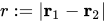
where is the intermolecular pair potential, is the distance between site 1 and site 2, is the hard diameter, is the energy well depth (), and is a parameter that controls the interaction range ().



The repulsive form has been used to study charge-stabilised colloid-colloid interactions.
Critical point
For the attractive form of the potential, from a study of the law of corresponding states, one has (Eq. 3 in [1])
- Failed to parse (SVG (MathML can be enabled via browser plugin): Invalid response ("Math extension cannot connect to Restbase.") from server "https://wikimedia.org/api/rest_v1/":): {\displaystyle P_c = 0.0228 + 0.0742 T_c}
and (Eq. 4)
- Failed to parse (SVG (MathML can be enabled via browser plugin): Invalid response ("Math extension cannot connect to Restbase.") from server "https://wikimedia.org/api/rest_v1/":): {\displaystyle \rho_c = 0.2534 + 0.071 \frac{1}{T_c}} .
The repulsive form of the potential has no critical point.
Triple points
The triple points for this model have been studied by Azhar and co-workers [2].
Virial coefficients
For the attractive form of the potential the virial coefficients have been calculated by Naresh and Singh [3].
Phase diagram
- Main article: Phase diagram of the Yukawa potential
Two-term Yukawa potentials
Both the attractive and the repulsive form have been combined to produce the hard-sphere plus two Yukawa potential (H2Y) [4].
References
- ↑ Pedro Orea and Yurko Duda "On the corresponding states law of the Yukawa fluid", Journal of Chemical Physics 128 134508 (2008)
- ↑ Fouad El Azhar, Marc Baus, Jean-Paul Ryckaert and Evert Jan Meijer "Line of triple points for the hard-core Yukawa model: A computer simulation study", Journal of Chemical Physics 112 pp. 5121- (2000)
- ↑ D.J. Naresh and Jayant K. Singh "Virial coefficients of hard-core attractive Yukawa fluids", Fluid Phase Equilibria 285 pp. 36-43 (2009)
- ↑ Lloyd L. Lee, Michael C. Hara, Steven J. Simon, Franklin S. Ramos, Andrew J. Winkle, and Jean-Marc Bomont "Crystallization limits of the two-term Yukawa potentials based on the entropy criterion", Journal of Chemical Physics 132 074505 (2010)
Related reading
- J. Torres-Arenas, L. A. Cervantes, A. L. Benavides, G. A. Chapela, and F. del Río "Discrete perturbation theory for the hard-core attractive and repulsive Yukawa potentials", Journal of Chemical Physics 132 034501 (2010)
- Pedro Orea, Carlos Tapia-Medina, Davide Pini, and Albert Reiner "Thermodynamic properties of short-range attractive Yukawa fluid: Simulation and theory", Journal of Chemical Physics 132 114108 (2010)