Ornstein-Zernike relation: Difference between revisions
Carl McBride (talk | contribs) m (Reverted edits by Marina D. Kung (Talk) to last version by Carl McBride) |
Carl McBride (talk | contribs) (Created a "notation" box.) |
||
| Line 1: | Line 1: | ||
Notation: | <div style="border:1px solid #f3f3ff; padding-left: 0.5em !important; background-color: #f3f3ff; border-width: 0 0 0 1.4em; clear:right; float:right;"> | ||
Notation used: | |||
*<math>g(r)</math> is the [[Pair distribution function | pair distribution function]]. | *<math>g(r)</math> is the [[Pair distribution function | pair distribution function]]. | ||
*<math>\Phi(r)</math> is the [[Intermolecular pair potential | pair potential]] acting between pairs. | *<math>\Phi(r)</math> is the [[Intermolecular pair potential | pair potential]] acting between pairs. | ||
| Line 9: | Line 10: | ||
*<math>\omega(r)</math> is the [[Thermal potential | thermal potential]]. | *<math>\omega(r)</math> is the [[Thermal potential | thermal potential]]. | ||
*<math>f(r)</math> is the [[Mayer f-function]]. | *<math>f(r)</math> is the [[Mayer f-function]]. | ||
</div> | |||
The '''Ornstein-Zernike relation''' (OZ) integral equation <ref>L. S. Ornstein and F. Zernike "Accidental deviations of density and opalescence at the critical point of a single substance", Koninklijke Nederlandse Akademie van Wetenschappen Amsterdam Proc. Sec. Sci. '''17''' pp. 793- (1914)</ref> is given by: | |||
The '''Ornstein-Zernike relation''' (OZ) integral equation is | |||
:<math>h=h\left[c\right]</math> | :<math>h=h\left[c\right]</math> | ||
where <math>h[c]</math> denotes a functional of <math>c</math>. This relation is exact. | where <math>h[c]</math> denotes a functional of <math>c</math>. This relation is exact. | ||
| Line 21: | Line 22: | ||
(Hansen and McDonald, section 5.2 p. 106) For a system in an external field, the OZ has the form (5.2.7) | (Hansen and McDonald, section 5.2 p. 106) For a system in an external field, the OZ has the form (5.2.7) | ||
:<math>h(1,2) = c(1,2) + \int \rho^{(1)}(3) c(1,3)h(3,2) d3</math> | :<math>h(1,2) = c(1,2) + \int \rho^{(1)}(3) c(1,3)h(3,2) d3</math> | ||
If the system is both homogeneous and isotropic, the OZ relation becomes (Ref. | If the system is both homogeneous and isotropic, the OZ relation becomes (Eq. 6 of Ref. 1) | ||
:<math>\gamma ({\mathbf r}) \equiv h({\mathbf r}) - c({\mathbf r}) = \rho \int h({\mathbf r'})~c(|{\mathbf r} - {\mathbf r'}|) {\rm d}{\mathbf r'}</math> | :<math>\gamma ({\mathbf r}) \equiv h({\mathbf r}) - c({\mathbf r}) = \rho \int h({\mathbf r'})~c(|{\mathbf r} - {\mathbf r'}|) {\rm d}{\mathbf r'}</math> | ||
In words, this equation (Hansen and McDonald, section 5.2 p. 107) | In words, this equation (Hansen and McDonald, section 5.2 p. 107) | ||
:"...describes the fact that the ''total'' correlation between particles 1 and 2, represented by <math>h(1,2)</math>, is due in part to the ''direct'' correlation between 1 and 2, represented by <math>c(1,2)</math>, but also to the ''indirect'' correlation, <math>\gamma (r)</math>, propagated via increasingly large numbers of intermediate particles." | |||
Notice that this equation is basically a convolution, ''i.e.'' | Notice that this equation is basically a convolution, ''i.e.'' | ||
| Line 48: | Line 47: | ||
:::::''etc.'' | :::::''etc.'' | ||
Diagrammatically this expression can be written as ( | Diagrammatically this expression can be written as <ref>[http://dx.doi.org/10.1103/PhysRevA.45.816 James A. Given "Liquid-state methods for random media: Random sequential adsorption", Physical Review A '''45''' pp. 816-824 (1992)]</ref>: | ||
:[[Image:oz_diag.png]] | :[[Image:oz_diag.png]] | ||
| Line 59: | Line 58: | ||
of the grand canonical distribution function (HM check this). | of the grand canonical distribution function (HM check this). | ||
==OZ equation in Fourier space== | ==OZ equation in Fourier space== | ||
The Ornstein-Zernike equation may be written in [[Fourier analysis |Fourier space]] as (Eq. 5 | The Ornstein-Zernike equation may be written in [[Fourier analysis |Fourier space]] as (<ref>[http://dx.doi.org/10.1063/1.470724 Der-Ming Duh and A. D. J. Haymet "Integral equation theory for uncharged liquids: The Lennard-Jones fluid and the bridge function", Journal of Chemical Physics '''103''' pp. 2625-2633 (1995)]</ref> Eq. 5): | ||
:<math>\hat{\gamma} = ({\mathbf I} - \rho {\mathbf \hat{c}})^{-1} {\mathbf \hat{c}} \rho {\mathbf \hat{c}}</math> | :<math>\hat{\gamma} = ({\mathbf I} - \rho {\mathbf \hat{c}})^{-1} {\mathbf \hat{c}} \rho {\mathbf \hat{c}}</math> | ||
| Line 79: | Line 78: | ||
==References== | ==References== | ||
<references/> | |||
'''Related reading''' | '''Related reading''' | ||
*Jean-Pierre Hansen and I.R. McDonald "Theory of Simple Liquids", Academic Press (2006) (Third Edition) ISBN 0-12-370535-5 § 3.5 | *Jean-Pierre Hansen and I.R. McDonald "Theory of Simple Liquids", Academic Press (2006) (Third Edition) ISBN 0-12-370535-5 § 3.5 | ||
Revision as of 16:15, 18 August 2010
Notation used:
- Failed to parse (SVG (MathML can be enabled via browser plugin): Invalid response ("Math extension cannot connect to Restbase.") from server "https://wikimedia.org/api/rest_v1/":): {\displaystyle g(r)} is the pair distribution function.
- Failed to parse (SVG (MathML can be enabled via browser plugin): Invalid response ("Math extension cannot connect to Restbase.") from server "https://wikimedia.org/api/rest_v1/":): {\displaystyle \Phi(r)} is the pair potential acting between pairs.
- Failed to parse (SVG (MathML can be enabled via browser plugin): Invalid response ("Math extension cannot connect to Restbase.") from server "https://wikimedia.org/api/rest_v1/":): {\displaystyle h(1,2)} is the total correlation function.
- Failed to parse (SVG (MathML can be enabled via browser plugin): Invalid response ("Math extension cannot connect to Restbase.") from server "https://wikimedia.org/api/rest_v1/":): {\displaystyle c(1,2)} is the direct correlation function.
- Failed to parse (SVG (MathML can be enabled via browser plugin): Invalid response ("Math extension cannot connect to Restbase.") from server "https://wikimedia.org/api/rest_v1/":): {\displaystyle \gamma (r)} is the indirect (or series or chain) correlation function.
- Failed to parse (SVG (MathML can be enabled via browser plugin): Invalid response ("Math extension cannot connect to Restbase.") from server "https://wikimedia.org/api/rest_v1/":): {\displaystyle y(r_{12})} is the cavity correlation function.
- Failed to parse (SVG (MathML can be enabled via browser plugin): Invalid response ("Math extension cannot connect to Restbase.") from server "https://wikimedia.org/api/rest_v1/":): {\displaystyle B(r)} is the bridge function.
- is the thermal potential.
- Failed to parse (SVG (MathML can be enabled via browser plugin): Invalid response ("Math extension cannot connect to Restbase.") from server "https://wikimedia.org/api/rest_v1/":): {\displaystyle f(r)} is the Mayer f-function.

The Ornstein-Zernike relation (OZ) integral equation [1] is given by:
- Failed to parse (SVG (MathML can be enabled via browser plugin): Invalid response ("Math extension cannot connect to Restbase.") from server "https://wikimedia.org/api/rest_v1/":): {\displaystyle h=h\left[c\right]}
where Failed to parse (SVG (MathML can be enabled via browser plugin): Invalid response ("Math extension cannot connect to Restbase.") from server "https://wikimedia.org/api/rest_v1/":): {\displaystyle h[c]} denotes a functional of Failed to parse (SVG (MathML can be enabled via browser plugin): Invalid response ("Math extension cannot connect to Restbase.") from server "https://wikimedia.org/api/rest_v1/":): {\displaystyle c} . This relation is exact. This is complemented by the closure relation
![{\displaystyle c=c\left[h\right]}](https://wikimedia.org/api/rest_v1/media/math/render/svg/3340b88402144027bfb655ef124c16d903cca221)
Note that Failed to parse (SVG (MathML can be enabled via browser plugin): Invalid response ("Math extension cannot connect to Restbase.") from server "https://wikimedia.org/api/rest_v1/":): {\displaystyle h} depends on Failed to parse (SVG (MathML can be enabled via browser plugin): Invalid response ("Math extension cannot connect to Restbase.") from server "https://wikimedia.org/api/rest_v1/":): {\displaystyle c} , and Failed to parse (SVG (MathML can be enabled via browser plugin): Invalid response ("Math extension cannot connect to Restbase.") from server "https://wikimedia.org/api/rest_v1/":): {\displaystyle c} depends on Failed to parse (SVG (MathML can be enabled via browser plugin): Invalid response ("Math extension cannot connect to Restbase.") from server "https://wikimedia.org/api/rest_v1/":): {\displaystyle h} . Because of this must be determined self-consistently. This need for self-consistency is characteristic of all many-body problems. (Hansen and McDonald, section 5.2 p. 106) For a system in an external field, the OZ has the form (5.2.7)

- Failed to parse (SVG (MathML can be enabled via browser plugin): Invalid response ("Math extension cannot connect to Restbase.") from server "https://wikimedia.org/api/rest_v1/":): {\displaystyle h(1,2) = c(1,2) + \int \rho^{(1)}(3) c(1,3)h(3,2) d3}
If the system is both homogeneous and isotropic, the OZ relation becomes (Eq. 6 of Ref. 1)
- Failed to parse (SVG (MathML can be enabled via browser plugin): Invalid response ("Math extension cannot connect to Restbase.") from server "https://wikimedia.org/api/rest_v1/":): {\displaystyle \gamma ({\mathbf r}) \equiv h({\mathbf r}) - c({\mathbf r}) = \rho \int h({\mathbf r'})~c(|{\mathbf r} - {\mathbf r'}|) {\rm d}{\mathbf r'}}
In words, this equation (Hansen and McDonald, section 5.2 p. 107)
- "...describes the fact that the total correlation between particles 1 and 2, represented by Failed to parse (SVG (MathML can be enabled via browser plugin): Invalid response ("Math extension cannot connect to Restbase.") from server "https://wikimedia.org/api/rest_v1/":): {\displaystyle h(1,2)} , is due in part to the direct correlation between 1 and 2, represented by Failed to parse (SVG (MathML can be enabled via browser plugin): Invalid response ("Math extension cannot connect to Restbase.") from server "https://wikimedia.org/api/rest_v1/":): {\displaystyle c(1,2)} , but also to the indirect correlation, , propagated via increasingly large numbers of intermediate particles."

Notice that this equation is basically a convolution, i.e.
- Failed to parse (SVG (MathML can be enabled via browser plugin): Invalid response ("Math extension cannot connect to Restbase.") from server "https://wikimedia.org/api/rest_v1/":): {\displaystyle h \equiv c + \rho h\otimes c }
(Note: the convolution operation written here as Failed to parse (SVG (MathML can be enabled via browser plugin): Invalid response ("Math extension cannot connect to Restbase.") from server "https://wikimedia.org/api/rest_v1/":): {\displaystyle \otimes} is more frequently written as Failed to parse (SVG (MathML can be enabled via browser plugin): Invalid response ("Math extension cannot connect to Restbase.") from server "https://wikimedia.org/api/rest_v1/":): {\displaystyle *} ) This can be seen by expanding the integral in terms of Failed to parse (SVG (MathML can be enabled via browser plugin): Invalid response ("Math extension cannot connect to Restbase.") from server "https://wikimedia.org/api/rest_v1/":): {\displaystyle h(r)} (here truncated at the fourth iteration):
- Failed to parse (SVG (MathML can be enabled via browser plugin): Invalid response ("Math extension cannot connect to Restbase.") from server "https://wikimedia.org/api/rest_v1/":): {\displaystyle h({\mathbf r}) = c({\mathbf r}) + \rho \int c(|{\mathbf r} - {\mathbf r'}|) c({\mathbf r'}) {\rm d}{\mathbf r'}}
- Failed to parse (SVG (MathML can be enabled via browser plugin): Invalid response ("Math extension cannot connect to Restbase.") from server "https://wikimedia.org/api/rest_v1/":): {\displaystyle + \rho^2 \iint c(|{\mathbf r} - {\mathbf r'}|) c(|{\mathbf r'} - {\mathbf r''}|) c({\mathbf r''}) {\rm d}{\mathbf r''}{\rm d}{\mathbf r'}}
- Failed to parse (SVG (MathML can be enabled via browser plugin): Invalid response ("Math extension cannot connect to Restbase.") from server "https://wikimedia.org/api/rest_v1/":): {\displaystyle + \rho^3 \iiint c(|{\mathbf r} - {\mathbf r'}|) c(|{\mathbf r'} - {\mathbf r''}|) c(|{\mathbf r''} - {\mathbf r'''}|) c({\mathbf r'''}) {\rm d}{\mathbf r'''}{\rm d}{\mathbf r''}{\rm d}{\mathbf r'}}
- Failed to parse (SVG (MathML can be enabled via browser plugin): Invalid response ("Math extension cannot connect to Restbase.") from server "https://wikimedia.org/api/rest_v1/":): {\displaystyle + \rho^4 \iiiint c(|{\mathbf r} - {\mathbf r'}|) c(|{\mathbf r'} - {\mathbf r''}|) c(|{\mathbf r''} - {\mathbf r'''}|) c(|{\mathbf r'''} - {\mathbf r''''}|) h({\mathbf r''''}) {\rm d}{\mathbf r''''} {\rm d}{\mathbf r'''}{\rm d}{\mathbf r''}{\rm d}{\mathbf r'}}
- etc.
Diagrammatically this expression can be written as [2]:

where the bold lines connecting root points denote Failed to parse (SVG (MathML can be enabled via browser plugin): Invalid response ("Math extension cannot connect to Restbase.") from server "https://wikimedia.org/api/rest_v1/":): {\displaystyle c} functions, the blobs denote functions. An arrow pointing from left to right indicates an uphill path from one root point to another. An `uphill path' is a sequence of Mayer bonds passing through increasing particle labels. The OZ relation can be derived by performing a functional differentiation of the grand canonical distribution function (HM check this).
OZ equation in Fourier space
The Ornstein-Zernike equation may be written in Fourier space as ([3] Eq. 5):
- Failed to parse (SVG (MathML can be enabled via browser plugin): Invalid response ("Math extension cannot connect to Restbase.") from server "https://wikimedia.org/api/rest_v1/":): {\displaystyle \hat{\gamma} = ({\mathbf I} - \rho {\mathbf \hat{c}})^{-1} {\mathbf \hat{c}} \rho {\mathbf \hat{c}}}
The carets denote the three-dimensional Fourier transformed quantities which reduce explicitly to:
- Failed to parse (SVG (MathML can be enabled via browser plugin): Invalid response ("Math extension cannot connect to Restbase.") from server "https://wikimedia.org/api/rest_v1/":): {\displaystyle \hat{\gamma} (k) = \frac{4 \pi}{k} \int_0^\infty r~\sin (kr) \gamma(r) dr}
- Failed to parse (SVG (MathML can be enabled via browser plugin): Invalid response ("Math extension cannot connect to Restbase.") from server "https://wikimedia.org/api/rest_v1/":): {\displaystyle \gamma (r) = \frac{1}{2 \pi^2 r} \int_0^\infty k~\sin (kr) \hat{\gamma}(r) dk}
Note:
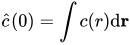
- Failed to parse (SVG (MathML can be enabled via browser plugin): Invalid response ("Math extension cannot connect to Restbase.") from server "https://wikimedia.org/api/rest_v1/":): {\displaystyle \hat{h}(0) = \int h(r) {\rm d}{\mathbf r}}
References
- ↑ L. S. Ornstein and F. Zernike "Accidental deviations of density and opalescence at the critical point of a single substance", Koninklijke Nederlandse Akademie van Wetenschappen Amsterdam Proc. Sec. Sci. 17 pp. 793- (1914)
- ↑ James A. Given "Liquid-state methods for random media: Random sequential adsorption", Physical Review A 45 pp. 816-824 (1992)
- ↑ Der-Ming Duh and A. D. J. Haymet "Integral equation theory for uncharged liquids: The Lennard-Jones fluid and the bridge function", Journal of Chemical Physics 103 pp. 2625-2633 (1995)
Related reading
- Jean-Pierre Hansen and I.R. McDonald "Theory of Simple Liquids", Academic Press (2006) (Third Edition) ISBN 0-12-370535-5 § 3.5