Semi-grand ensembles: Difference between revisions
| Line 34: | Line 34: | ||
: <math> d \left( \beta A \right) = E d \beta - (\beta p) d V + \beta \mu_1 d N - \beta \mu_1 d | : <math> d \left( \beta A \right) = E d \beta - (\beta p) d V + \beta \mu_1 d N - \beta \mu_1 \sum_{i=2}^c d N_i + \sum_{i=2}^c \beta \mu_2 d N_2; </math> | ||
: <math> d \left( \beta A \right) = E d \beta - (\beta p) d V + \beta \mu_1 d N + \beta (\mu_2-\ | : <math> d \left( \beta A \right) = E d \beta - (\beta p) d V + \beta \mu_1 d N + \sum_{i=2}^c \beta (\mu_2-\mu_i) d N_i; </math> | ||
Or: | Or: | ||
: <math> d \left( \beta A \right) = E d \beta - (\beta p) d V + \beta \mu_1 d N + \beta \mu_{ | : <math> d \left( \beta A \right) = E d \beta - (\beta p) d V + \beta \mu_1 d N + \sum_{i=2}^c \beta \mu_{i1} d N_i; </math> | ||
where <math> \mu_{ | where <math> \left. \mu_{i1} \equiv \mu_i - \mu_1 \right. </math>. Now considering the thermodynamical potential: <math> \beta A - \sum_{i=2}^c \left( N_i \beta \mu_{i1} \right) </math> | ||
:<math> d \left | :<math> d \left[ \beta A - \sum_{i=2}^c ( \beta \mu_{i1} N_i ) \right] = E d \beta - \left( \beta p \right) d V + \beta \mu_{1} d N - N_2 d \left( \beta \mu_{21} \right). | ||
</math> | </math> | ||
Revision as of 16:52, 5 March 2007
General Features
Semi-grand ensembles are used in Monte Carlo simulation of mixtures.
In this ensembles the total number of molecules is fixed, but the composition can change.
Canonical Ensemble: fixed volume, temperature and number(s) of molecules
We will consider a system with "c" components;. In the Canonical Ensemble, the differential equation energy for the Helmholtz energy function can be written as:
- Failed to parse (SVG (MathML can be enabled via browser plugin): Invalid response ("Math extension cannot connect to Restbase.") from server "https://wikimedia.org/api/rest_v1/":): {\displaystyle d \left( \beta A \right) = E d \beta - (\beta p) d V + \sum_{i=1}^c (\beta \mu_i) d N_i } ,
where:
- Failed to parse (SVG (MathML can be enabled via browser plugin): Invalid response ("Math extension cannot connect to Restbase.") from server "https://wikimedia.org/api/rest_v1/":): {\displaystyle A } is the Helmholtz energy function
- Failed to parse (SVG (MathML can be enabled via browser plugin): Invalid response ("Math extension cannot connect to Restbase.") from server "https://wikimedia.org/api/rest_v1/":): {\displaystyle \beta \equiv 1/k_B T }
- Failed to parse (SVG (MathML can be enabled via browser plugin): Invalid response ("Math extension cannot connect to Restbase.") from server "https://wikimedia.org/api/rest_v1/":): {\displaystyle k_B} is the Boltzmann constant
- Failed to parse (SVG (MathML can be enabled via browser plugin): Invalid response ("Math extension cannot connect to Restbase.") from server "https://wikimedia.org/api/rest_v1/":): {\displaystyle T } is the absolute temperature
- Failed to parse (SVG (MathML can be enabled via browser plugin): Invalid response ("Math extension cannot connect to Restbase.") from server "https://wikimedia.org/api/rest_v1/":): {\displaystyle E } is the internal energy
- Failed to parse (SVG (MathML can be enabled via browser plugin): Invalid response ("Math extension cannot connect to Restbase.") from server "https://wikimedia.org/api/rest_v1/":): {\displaystyle p } is the pressure
- Failed to parse (SVG (MathML can be enabled via browser plugin): Invalid response ("Math extension cannot connect to Restbase.") from server "https://wikimedia.org/api/rest_v1/":): {\displaystyle \mu_i } is the chemical potential of the species "i"
- Failed to parse (SVG (MathML can be enabled via browser plugin): Invalid response ("Math extension cannot connect to Restbase.") from server "https://wikimedia.org/api/rest_v1/":): {\displaystyle N_i } is the number of molecules of the species "i"
Semi-grand ensemble at fixed volume and temperature
Consider now that we want to consider a system with fixed total number of particles,

- Failed to parse (SVG (MathML can be enabled via browser plugin): Invalid response ("Math extension cannot connect to Restbase.") from server "https://wikimedia.org/api/rest_v1/":): {\displaystyle \left. N = \sum_{i=1}^c N_i \right. } ;
but the composition can change, from the thermodynamics we can apply a Legendre's transform [HAVE TO CHECK ACCURACY] to the differential equation written above in terms of Failed to parse (SVG (MathML can be enabled via browser plugin): Invalid response ("Math extension cannot connect to Restbase.") from server "https://wikimedia.org/api/rest_v1/":): {\displaystyle A (T,V,N_1,N_2) } .
- Consider the variable change Failed to parse (SVG (MathML can be enabled via browser plugin): Invalid response ("Math extension cannot connect to Restbase.") from server "https://wikimedia.org/api/rest_v1/":): {\displaystyle N_1 \rightarrow N } i.e.:
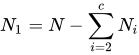
- Failed to parse (SVG (MathML can be enabled via browser plugin): Invalid response ("Math extension cannot connect to Restbase.") from server "https://wikimedia.org/api/rest_v1/":): {\displaystyle d \left( \beta A \right) = E d \beta - (\beta p) d V + \beta \mu_1 d N - \beta \mu_1 \sum_{i=2}^c d N_i + \sum_{i=2}^c \beta \mu_2 d N_2; }
- Failed to parse (SVG (MathML can be enabled via browser plugin): Invalid response ("Math extension cannot connect to Restbase.") from server "https://wikimedia.org/api/rest_v1/":): {\displaystyle d \left( \beta A \right) = E d \beta - (\beta p) d V + \beta \mu_1 d N + \sum_{i=2}^c \beta (\mu_2-\mu_i) d N_i; }
Or:
- Failed to parse (SVG (MathML can be enabled via browser plugin): Invalid response ("Math extension cannot connect to Restbase.") from server "https://wikimedia.org/api/rest_v1/":): {\displaystyle d \left( \beta A \right) = E d \beta - (\beta p) d V + \beta \mu_1 d N + \sum_{i=2}^c \beta \mu_{i1} d N_i; }
where Failed to parse (SVG (MathML can be enabled via browser plugin): Invalid response ("Math extension cannot connect to Restbase.") from server "https://wikimedia.org/api/rest_v1/":): {\displaystyle \left. \mu_{i1} \equiv \mu_i - \mu_1 \right. } . Now considering the thermodynamical potential: Failed to parse (SVG (MathML can be enabled via browser plugin): Invalid response ("Math extension cannot connect to Restbase.") from server "https://wikimedia.org/api/rest_v1/":): {\displaystyle \beta A - \sum_{i=2}^c \left( N_i \beta \mu_{i1} \right) }
- Failed to parse (SVG (MathML can be enabled via browser plugin): Invalid response ("Math extension cannot connect to Restbase.") from server "https://wikimedia.org/api/rest_v1/":): {\displaystyle d \left[ \beta A - \sum_{i=2}^c ( \beta \mu_{i1} N_i ) \right] = E d \beta - \left( \beta p \right) d V + \beta \mu_{1} d N - N_2 d \left( \beta \mu_{21} \right). }
Fixed pressure and temperature
In the Isothermal-Isobaric ensemble: Failed to parse (SVG (MathML can be enabled via browser plugin): Invalid response ("Math extension cannot connect to Restbase.") from server "https://wikimedia.org/api/rest_v1/":): {\displaystyle (N_1,N_2, \cdots, N_c, p, T) } ensemble we can write:
Failed to parse (SVG (MathML can be enabled via browser plugin): Invalid response ("Math extension cannot connect to Restbase.") from server "https://wikimedia.org/api/rest_v1/":): {\displaystyle d (\beta G) = E d \beta + V d (\beta p) + \sum_{i=1}^c \left( \beta \mu_i \right) d N_i }
where:
- is the Gibbs energy function
