Heaviside step distribution: Difference between revisions
Carl McBride (talk | contribs) No edit summary |
Carl McBride (talk | contribs) No edit summary |
||
| Line 26: | Line 26: | ||
:<math>\frac{{\rm d}}{{\rm d}x} H_{\epsilon}(x-a)= \frac{1}{\epsilon}\left( H(x - (a-\frac{\epsilon}{2})) - H (x - (a+\frac{\epsilon}{2}))\right)</math> | :<math>\frac{{\rm d}}{{\rm d}x} H_{\epsilon}(x-a)= \frac{1}{\epsilon}\left( H(x - (a-\frac{\epsilon}{2})) - H (x - (a+\frac{\epsilon}{2}))\right)</math> | ||
in the limit this is the [[Dirac delta | in the limit this is the [[Dirac delta distribution]]. Thus | ||
:<math>\frac{{\rm d}}{{\rm d}x} [H(x)]= \delta(x)</math>. | |||
==References== | ==References== | ||
#[http://store.doverpublications.com/0486612724.html Milton Abramowitz and Irene A. Stegun "Handbook of Mathematical Functions" Dover Publications ninth printing.] | #[http://store.doverpublications.com/0486612724.html Milton Abramowitz and Irene A. Stegun "Handbook of Mathematical Functions" Dover Publications ninth printing.] | ||
[[category:mathematics]] | [[category:mathematics]] | ||
Revision as of 11:34, 29 May 2007
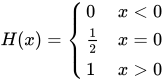
The Heaviside step distribution is defined by (Abramowitz and Stegun Eq. 29.1.3, p. 1020):
Differentiating the Heaviside distribution
At first glance things are hopeless:
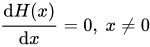
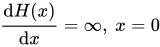
however, lets define a less brutal jump in the form of a linear slope such that

in the limit Failed to parse (SVG (MathML can be enabled via browser plugin): Invalid response ("Math extension cannot connect to Restbase.") from server "https://wikimedia.org/api/rest_v1/":): {\displaystyle \epsilon \rightarrow 0} this becomes the Heaviside function Failed to parse (SVG (MathML can be enabled via browser plugin): Invalid response ("Math extension cannot connect to Restbase.") from server "https://wikimedia.org/api/rest_v1/":): {\displaystyle H(x-a)} . However, lets differentiate first:
- Failed to parse (SVG (MathML can be enabled via browser plugin): Invalid response ("Math extension cannot connect to Restbase.") from server "https://wikimedia.org/api/rest_v1/":): {\displaystyle \frac{{\rm d}}{{\rm d}x} H_{\epsilon}(x-a)= \frac{1}{\epsilon}\left( H(x - (a-\frac{\epsilon}{2})) - H (x - (a+\frac{\epsilon}{2}))\right)}
in the limit this is the Dirac delta distribution. Thus
- Failed to parse (SVG (MathML can be enabled via browser plugin): Invalid response ("Math extension cannot connect to Restbase.") from server "https://wikimedia.org/api/rest_v1/":): {\displaystyle \frac{{\rm d}}{{\rm d}x} [H(x)]= \delta(x)} .