Ideal gas partition function: Difference between revisions
Carl McBride (talk | contribs) No edit summary |
mNo edit summary |
||
| Line 2: | Line 2: | ||
for a system of ''N'' identical particles each of mass ''m'' is given by | for a system of ''N'' identical particles each of mass ''m'' is given by | ||
:<math>Q_{NVT}=\frac{1}{N!}\frac{1}{h^{3N}}\int\int | :<math>Q_{NVT}=\frac{1}{N!}\frac{1}{h^{3N}}\int\int d{\mathbf p}^N d{\mathbf r}^N \exp \left[ - \frac{H({\mathbf p}^N,{\mathbf r}^N)}{k_B T}\right]</math> | ||
where ''h'' is [[Planck's constant]], ''T'' is the [[temperature]] and <math>k_B</math> is the [[Boltzmann constant]]. When the particles are distinguishable then the factor ''N!'' disappears. <math>H(p^N, r^N)</math> is the [[Hamiltonian]] | where ''h'' is [[Planck's constant]], ''T'' is the [[temperature]] and <math>k_B</math> is the [[Boltzmann constant]]. When the particles are distinguishable then the factor ''N!'' disappears. <math>H(p^N, r^N)</math> is the [[Hamiltonian]] | ||
| Line 9: | Line 9: | ||
The Hamiltonian can be written as the sum of the kinetic and the potential energies of the system as follows | The Hamiltonian can be written as the sum of the kinetic and the potential energies of the system as follows | ||
:<math>H(p^N, r^N)= \sum_{i=1}^N \frac{| | :<math>H({\mathbf p}^N, {\mathbf r}^N)= \sum_{i=1}^N \frac{|{\mathbf p}_i |^2}{2m} + {\mathcal V}({\mathbf r}^N)</math> | ||
Thus we have | Thus we have | ||
:<math>Q_{NVT}=\frac{1}{N!}\frac{1}{h^{3N}}\int | :<math>Q_{NVT}=\frac{1}{N!}\frac{1}{h^{3N}}\int d{\mathbf p}^N \exp \left[ - \frac{|{\mathbf p}_i |^2}{2mk_B T}\right] | ||
\int | \int d{\mathbf r}^N \exp \left[ - \frac{{\mathcal V}({\mathbf r}^N)} {k_B T}\right]</math> | ||
This separation is only possible if <math>V(r^N)</math> is independent of velocity (as is generally the case). | This separation is only possible if <math>{\mathcal V}({\mathbf r}^N)</math> is independent of velocity (as is generally the case). | ||
The momentum integral can be solved analytically: | The momentum integral can be solved analytically: | ||
:<math>\int | :<math>\int d{\mathbf p}^N \exp \left[ - \frac{|{\mathbf p} |^2}{2mk_B T}\right]=(2 \pi m k_B T)^{3N/2}</math> | ||
Thus we have | Thus we have | ||
:<math>Q_{NVT}=\frac{1}{N!} \frac{1}{h^{3N}} \left( 2 \pi m k_B T\right)^{3N/2} | :<math>Q_{NVT}=\frac{1}{N!} \frac{1}{h^{3N}} \left( 2 \pi m k_B T\right)^{3N/2} | ||
\int | \int d{\mathbf r}^N \exp \left[ - \frac{{\mathcal V}({\mathbf r}^N)} {k_B T}\right]</math> | ||
The integral over positions is known as the ''configuration integral'', <math>Z_{NVT}</math> (from the German ''Zustandssumme'' meaning "sum over states") | The integral over positions is known as the ''configuration integral'', <math>Z_{NVT}</math> (from the German ''Zustandssumme'' meaning "sum over states") | ||
:<math>Z_{NVT}= \int | :<math>Z_{NVT}= \int d{\mathbf r}^N \exp \left[ - \frac{{\mathcal V}({\mathbf r}^N)} {k_B T}\right]</math> | ||
In an [[ideal gas]] there are no interactions between particles so <math>\ | In an [[ideal gas]] there are no interactions between particles so <math>{\mathcal V}({\mathbf r}^N)=0</math>. | ||
Thus <math>\exp(-\ | Thus <math>\exp(-{\mathcal V}({\mathbf r}^N)/k_B T)=1</math> for every gas particle. | ||
The integral of 1 over the coordinates of each atom is equal to the volume so for ''N'' particles | The integral of 1 over the coordinates of each atom is equal to the volume so for ''N'' particles | ||
the ''configuration integral'' is given by <math>V^N</math> where ''V'' is the volume. | the ''configuration integral'' is given by <math>V^N</math> where ''V'' is the volume. | ||
Revision as of 16:12, 10 July 2007
The canonical ensemble partition function, Q, for a system of N identical particles each of mass m is given by
- Failed to parse (SVG (MathML can be enabled via browser plugin): Invalid response ("Math extension cannot connect to Restbase.") from server "https://wikimedia.org/api/rest_v1/":): {\displaystyle Q_{NVT}=\frac{1}{N!}\frac{1}{h^{3N}}\int\int d{\mathbf p}^N d{\mathbf r}^N \exp \left[ - \frac{H({\mathbf p}^N,{\mathbf r}^N)}{k_B T}\right]}
where h is Planck's constant, T is the temperature and Failed to parse (SVG (MathML can be enabled via browser plugin): Invalid response ("Math extension cannot connect to Restbase.") from server "https://wikimedia.org/api/rest_v1/":): {\displaystyle k_B} is the Boltzmann constant. When the particles are distinguishable then the factor N! disappears. Failed to parse (SVG (MathML can be enabled via browser plugin): Invalid response ("Math extension cannot connect to Restbase.") from server "https://wikimedia.org/api/rest_v1/":): {\displaystyle H(p^N, r^N)} is the Hamiltonian corresponding to the total energy of the system. H is a function of the 3N positions and 3N momenta of the particles in the system. The Hamiltonian can be written as the sum of the kinetic and the potential energies of the system as follows
- Failed to parse (SVG (MathML can be enabled via browser plugin): Invalid response ("Math extension cannot connect to Restbase.") from server "https://wikimedia.org/api/rest_v1/":): {\displaystyle H({\mathbf p}^N, {\mathbf r}^N)= \sum_{i=1}^N \frac{|{\mathbf p}_i |^2}{2m} + {\mathcal V}({\mathbf r}^N)}
Thus we have
- Failed to parse (SVG (MathML can be enabled via browser plugin): Invalid response ("Math extension cannot connect to Restbase.") from server "https://wikimedia.org/api/rest_v1/":): {\displaystyle Q_{NVT}=\frac{1}{N!}\frac{1}{h^{3N}}\int d{\mathbf p}^N \exp \left[ - \frac{|{\mathbf p}_i |^2}{2mk_B T}\right] \int d{\mathbf r}^N \exp \left[ - \frac{{\mathcal V}({\mathbf r}^N)} {k_B T}\right]}
This separation is only possible if Failed to parse (SVG (MathML can be enabled via browser plugin): Invalid response ("Math extension cannot connect to Restbase.") from server "https://wikimedia.org/api/rest_v1/":): {\displaystyle {\mathcal V}({\mathbf r}^N)} is independent of velocity (as is generally the case). The momentum integral can be solved analytically:
- Failed to parse (SVG (MathML can be enabled via browser plugin): Invalid response ("Math extension cannot connect to Restbase.") from server "https://wikimedia.org/api/rest_v1/":): {\displaystyle \int d{\mathbf p}^N \exp \left[ - \frac{|{\mathbf p} |^2}{2mk_B T}\right]=(2 \pi m k_B T)^{3N/2}}
Thus we have
- Failed to parse (SVG (MathML can be enabled via browser plugin): Invalid response ("Math extension cannot connect to Restbase.") from server "https://wikimedia.org/api/rest_v1/":): {\displaystyle Q_{NVT}=\frac{1}{N!} \frac{1}{h^{3N}} \left( 2 \pi m k_B T\right)^{3N/2} \int d{\mathbf r}^N \exp \left[ - \frac{{\mathcal V}({\mathbf r}^N)} {k_B T}\right]}
The integral over positions is known as the configuration integral, Failed to parse (SVG (MathML can be enabled via browser plugin): Invalid response ("Math extension cannot connect to Restbase.") from server "https://wikimedia.org/api/rest_v1/":): {\displaystyle Z_{NVT}}
(from the German Zustandssumme meaning "sum over states")
- Failed to parse (SVG (MathML can be enabled via browser plugin): Invalid response ("Math extension cannot connect to Restbase.") from server "https://wikimedia.org/api/rest_v1/":): {\displaystyle Z_{NVT}= \int d{\mathbf r}^N \exp \left[ - \frac{{\mathcal V}({\mathbf r}^N)} {k_B T}\right]}
In an ideal gas there are no interactions between particles so Failed to parse (SVG (MathML can be enabled via browser plugin): Invalid response ("Math extension cannot connect to Restbase.") from server "https://wikimedia.org/api/rest_v1/":): {\displaystyle {\mathcal V}({\mathbf r}^N)=0} . Thus Failed to parse (SVG (MathML can be enabled via browser plugin): Invalid response ("Math extension cannot connect to Restbase.") from server "https://wikimedia.org/api/rest_v1/":): {\displaystyle \exp(-{\mathcal V}({\mathbf r}^N)/k_B T)=1} for every gas particle. The integral of 1 over the coordinates of each atom is equal to the volume so for N particles the configuration integral is given by Failed to parse (SVG (MathML can be enabled via browser plugin): Invalid response ("Math extension cannot connect to Restbase.") from server "https://wikimedia.org/api/rest_v1/":): {\displaystyle V^N} where V is the volume. Thus we have
- Failed to parse (SVG (MathML can be enabled via browser plugin): Invalid response ("Math extension cannot connect to Restbase.") from server "https://wikimedia.org/api/rest_v1/":): {\displaystyle Q_{NVT}=\frac{V^N}{N!}\left( \frac{2 \pi m k_B T}{h^2}\right)^{3N/2}}
If we define the de Broglie thermal wavelength as Failed to parse (SVG (MathML can be enabled via browser plugin): Invalid response ("Math extension cannot connect to Restbase.") from server "https://wikimedia.org/api/rest_v1/":): {\displaystyle \Lambda} where
- Failed to parse (SVG (MathML can be enabled via browser plugin): Invalid response ("Math extension cannot connect to Restbase.") from server "https://wikimedia.org/api/rest_v1/":): {\displaystyle \Lambda = \sqrt{h^2 / 2 \pi m k_B T}}
one arrives at
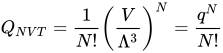
where
- Failed to parse (SVG (MathML can be enabled via browser plugin): Invalid response ("Math extension cannot connect to Restbase.") from server "https://wikimedia.org/api/rest_v1/":): {\displaystyle q= \frac{V}{\Lambda^{3}}}
is the single particle translational partition function.
Thus one can now write the partition function for a real system can be built up from the contribution of the ideal system (the momenta) and a contribution due to particle interactions, i.e.
- Failed to parse (SVG (MathML can be enabled via browser plugin): Invalid response ("Math extension cannot connect to Restbase.") from server "https://wikimedia.org/api/rest_v1/":): {\displaystyle Q_{NVT}=Q_{NVT}^{\rm ideal} ~Q_{NVT}^{\rm excess}}