Second virial coefficient: Difference between revisions
Carl McBride (talk | contribs) No edit summary |
||
| Line 28: | Line 28: | ||
*[[Virial equation of state]] | *[[Virial equation of state]] | ||
*[[Boyle temperature]] | *[[Boyle temperature]] | ||
*[[Joule-Thomson effect#Joule-Thomson coefficient | Joule-Thomson coefficient]] | |||
==References== | ==References== | ||
[[Category: Virial coefficients]] | [[Category: Virial coefficients]] | ||
Revision as of 12:45, 12 July 2007
The second virial coefficient is usually written as B or as Failed to parse (SVG (MathML can be enabled via browser plugin): Invalid response ("Math extension cannot connect to Restbase.") from server "https://wikimedia.org/api/rest_v1/":): {\displaystyle B_2} . The second virial coefficient represents the initial departure from ideal-gas behavior. The second virial coefficient is given by
- Failed to parse (SVG (MathML can be enabled via browser plugin): Invalid response ("Math extension cannot connect to Restbase.") from server "https://wikimedia.org/api/rest_v1/":): {\displaystyle B_{2}(T)= - \frac{1}{2} \int \left( \left\langle \exp\left(-\frac{\Phi_{12}({\mathbf r})}{k_BT}\right)\right\rangle -1 \right) 4 \pi r^2 dr }
where is the intermolecular pair potential, T is the temperature and Failed to parse (SVG (MathML can be enabled via browser plugin): Invalid response ("Math extension cannot connect to Restbase.") from server "https://wikimedia.org/api/rest_v1/":): {\displaystyle k_B} is the Boltzmann constant. Notice that the expression within the parenthesis of the integral is the Mayer f-function.
For any hard convex body
The second virial coefficient for any hard convex body is given by the exact relation
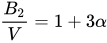
- Failed to parse (SVG (MathML can be enabled via browser plugin): Invalid response ("Math extension cannot connect to Restbase.") from server "https://wikimedia.org/api/rest_v1/":): {\displaystyle \frac{B_2}{V}=1+3 \alpha}
where
- Failed to parse (SVG (MathML can be enabled via browser plugin): Invalid response ("Math extension cannot connect to Restbase.") from server "https://wikimedia.org/api/rest_v1/":): {\displaystyle \alpha = \frac{RS}{3V}}
where Failed to parse (SVG (MathML can be enabled via browser plugin): Invalid response ("Math extension cannot connect to Restbase.") from server "https://wikimedia.org/api/rest_v1/":): {\displaystyle V} is the volume, , the surface area, and Failed to parse (SVG (MathML can be enabled via browser plugin): Invalid response ("Math extension cannot connect to Restbase.") from server "https://wikimedia.org/api/rest_v1/":): {\displaystyle R} the mean radius of curvature.
Hard spheres
For hard spheres one has (McQuarrie, 1976, eq. 12-40)

- Failed to parse (SVG (MathML can be enabled via browser plugin): Invalid response ("Math extension cannot connect to Restbase.") from server "https://wikimedia.org/api/rest_v1/":): {\displaystyle B_{2}(T)= - \frac{1}{2} \int_0^\sigma \left(\langle 0\rangle -1 \right) 4 \pi r^2 dr }
leading to
- Failed to parse (SVG (MathML can be enabled via browser plugin): Invalid response ("Math extension cannot connect to Restbase.") from server "https://wikimedia.org/api/rest_v1/":): {\displaystyle B_{2}= \frac{2\pi\sigma^3}{3}}
Note that Failed to parse (SVG (MathML can be enabled via browser plugin): Invalid response ("Math extension cannot connect to Restbase.") from server "https://wikimedia.org/api/rest_v1/":): {\displaystyle B_{2}} for the hard sphere is independent of temperature.
