Binder cumulant: Difference between revisions
No edit summary |
Carl McBride (talk | contribs) m (Slight tidy.) |
||
| Line 1: | Line 1: | ||
The '''Binder cumulant''' was introduced by Kurt Binder in the context of finite size scaling. It is a quantity that is supposed to be invariant for different system sizes at criticality. For an [[Ising Models |Ising model]] with zero field, is given by | The '''Binder cumulant''' was introduced by [[Kurt Binder]] in the context of [[Finite size effects |finite size scaling]]. It is a quantity that is supposed to be invariant for different system sizes at criticality. For an [[Ising Models |Ising model]] with zero field, it is given by | ||
:<math>U_4 = 1- \frac{\langle m^4 \rangle }{3\langle m^2 \rangle^2 }</math> | :<math>U_4 = 1- \frac{\langle m^4 \rangle }{3\langle m^2 \rangle^2 }</math> | ||
where ''m'' is the [[Order parameters |order parameter]]. It is therefore a fourth order cumulant, related to the kurtosis. | where ''m'' is the [[Order parameters |order parameter]]. It is therefore a fourth order cumulant, related to the kurtosis. | ||
In the [[thermodynamic limit]], where the system size <math>L \rightarrow \infty</math>, <math>U_4 \rightarrow 0</math> for <math>T > T_c</math>, and <math>U_4 \rightarrow 2/3</math> for <math>T < T_c</math>. Thus, the function is discontinuous in this limit. The useful fact is that curves corresponding to different system sizes (which are, of course, continuous) all intersect at approximately the same [[temperature]], which provides a convenient estimate for the value of the [[Critical points |critical temperature]]. | |||
In the [[thermodynamic limit]], where the system size <math>L \rightarrow \infty</math>, <math>U_4 \rightarrow 0</math> for <math>T > T_c</math>, and <math>U_4 \rightarrow 2/3</math> for <math>T < T_c</math>. Thus, the function is discontinuous in this limit | |||
==References== | ==References== | ||
#[http://dx.doi.org/10.1007/BF01293604 K. Binder "Finite size scaling analysis of ising model block distribution functions", Zeitschrift für Physik B Condensed Matter '''43''' pp. 119-140 (1981)] | #[http://dx.doi.org/10.1007/BF01293604 K. Binder "Finite size scaling analysis of ising model block distribution functions", Zeitschrift für Physik B Condensed Matter '''43''' pp. 119-140 (1981)] | ||
Revision as of 11:37, 12 November 2007
The Binder cumulant was introduced by Kurt Binder in the context of finite size scaling. It is a quantity that is supposed to be invariant for different system sizes at criticality. For an Ising model with zero field, it is given by
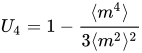
where m is the order parameter. It is therefore a fourth order cumulant, related to the kurtosis. In the thermodynamic limit, where the system size Failed to parse (SVG (MathML can be enabled via browser plugin): Invalid response ("Math extension cannot connect to Restbase.") from server "https://wikimedia.org/api/rest_v1/":): {\displaystyle L \rightarrow \infty} , Failed to parse (SVG (MathML can be enabled via browser plugin): Invalid response ("Math extension cannot connect to Restbase.") from server "https://wikimedia.org/api/rest_v1/":): {\displaystyle U_4 \rightarrow 0} for Failed to parse (SVG (MathML can be enabled via browser plugin): Invalid response ("Math extension cannot connect to Restbase.") from server "https://wikimedia.org/api/rest_v1/":): {\displaystyle T > T_c} , and Failed to parse (SVG (MathML can be enabled via browser plugin): Invalid response ("Math extension cannot connect to Restbase.") from server "https://wikimedia.org/api/rest_v1/":): {\displaystyle U_4 \rightarrow 2/3} for . Thus, the function is discontinuous in this limit. The useful fact is that curves corresponding to different system sizes (which are, of course, continuous) all intersect at approximately the same temperature, which provides a convenient estimate for the value of the critical temperature.
