XY model: Difference between revisions
Jump to navigation
Jump to search
Carl McBride (talk | contribs) No edit summary |
Carl McBride (talk | contribs) mNo edit summary |
||
| Line 1: | Line 1: | ||
{{Stub-general}} | {{Stub-general}} | ||
The '''XY model''', also known as the ''O(2)'' model, is a Heisenberg ferromagnetic with an easy-plane anisotropy. | The '''XY model''', also known as the ''O(2)'' model because of its symmetry group, is a Heisenberg ferromagnetic with an easy-plane anisotropy. The [[Hamiltonian]] is given by | ||
:<math>H = -J{\sum}_{\langle i,j\rangle}\mathbf{S}_i \cdot \mathbf{S}_{j}</math> | |||
in other words | |||
:<math>H=-J{\sum}_{\langle i,j\rangle}\cos(\theta_i-\theta_j)</math> | |||
where the sum runs over all pairs of nearest neighbour spins, <math>\mathbf{S}</math>, and where <math>J</math> is the coupling constant. | |||
==Random field XY model (RFXY)== | ==Random field XY model (RFXY)== | ||
==XY universality class== | ==XY universality class== | ||
Revision as of 17:14, 22 January 2008

|
This article is a 'stub' page, it has no, or next to no, content. It is here at the moment to help form part of the structure of SklogWiki. If you add sufficient material to this article then please remove the {{Stub-general}} template from this page. |
The XY model, also known as the O(2) model because of its symmetry group, is a Heisenberg ferromagnetic with an easy-plane anisotropy. The Hamiltonian is given by
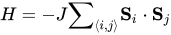
in other words
- Failed to parse (SVG (MathML can be enabled via browser plugin): Invalid response ("Math extension cannot connect to Restbase.") from server "https://wikimedia.org/api/rest_v1/":): {\displaystyle H=-J{\sum}_{\langle i,j\rangle}\cos(\theta_i-\theta_j)}
where the sum runs over all pairs of nearest neighbour spins, Failed to parse (SVG (MathML can be enabled via browser plugin): Invalid response ("Math extension cannot connect to Restbase.") from server "https://wikimedia.org/api/rest_v1/":): {\displaystyle \mathbf{S}} , and where Failed to parse (SVG (MathML can be enabled via browser plugin): Invalid response ("Math extension cannot connect to Restbase.") from server "https://wikimedia.org/api/rest_v1/":): {\displaystyle J} is the coupling constant.