Mie potential: Difference between revisions
Jump to navigation
Jump to search
Carl McBride (talk | contribs) m (→(14,7) model: Added a new reference) |
m (Better defined r) |
||
| Line 1: | Line 1: | ||
The '''Mie potential''' was proposed by Gustav Mie in 1903. It is given by | The '''Mie potential''' was proposed by Gustav Mie in 1903. It is given by | ||
:<math> \ | :<math> \Phi_{12}(r) = \left( \frac{n}{n-m}\right) \left( \frac{n}{m}\right)^{m/(n-m)} \epsilon \left[ \left(\frac{\sigma}{r} \right)^{n}- \left( \frac{\sigma}{r}\right)^m \right] </math> | ||
where: | where: | ||
* <math> \ | * <math>r := |\mathbf{r}_1 - \mathbf{r}_2|</math> | ||
* <math> \Phi_{12}(r) </math> is the [[intermolecular pair potential]] between two particles at a distance r; | |||
* <math> \sigma </math> is the diameter (length), i.e. the value of <math>r</math> at <math> \Phi(r)=0</math> ; | * <math> \sigma </math> is the diameter (length), i.e. the value of <math>r</math> at <math> \Phi(r)=0</math> ; | ||
* <math> \epsilon </math> : well depth (energy) | * <math> \epsilon </math> : well depth (energy) | ||
| Line 10: | Line 11: | ||
#[http://dx.doi.org/10.1063/1.2901164 Afshin Eskandari Nasrabad "Monte Carlo simulations of thermodynamic and structural properties of Mie(14,7) fluids", Journal of Chemical Physics '''128''' 154514 (2008)] | #[http://dx.doi.org/10.1063/1.2901164 Afshin Eskandari Nasrabad "Monte Carlo simulations of thermodynamic and structural properties of Mie(14,7) fluids", Journal of Chemical Physics '''128''' 154514 (2008)] | ||
#[http://dx.doi.org/10.1063/1.2953331 Afshin Eskandari Nasrabad, Nader Mansoori Oghaz, and Behzad Haghighi "Transport properties of Mie(14,7) fluids: Molecular dynamics simulation and theory", Journal of Chemical Physics '''129''' 024507 (2008)] | #[http://dx.doi.org/10.1063/1.2953331 Afshin Eskandari Nasrabad, Nader Mansoori Oghaz, and Behzad Haghighi "Transport properties of Mie(14,7) fluids: Molecular dynamics simulation and theory", Journal of Chemical Physics '''129''' 024507 (2008)] | ||
==References== | ==References== | ||
#[http://dx.doi.org/10.1002/andp.19033160802 Gustav Mie "Zur kinetischen Theorie der einatomigen Körper", Annalen der Physik '''11''' pp. 657-697 (1903)] (check this reference) | #[http://dx.doi.org/10.1002/andp.19033160802 Gustav Mie "Zur kinetischen Theorie der einatomigen Körper", Annalen der Physik '''11''' pp. 657-697 (1903)] (check this reference) | ||
[[Category: Models]] | [[Category: Models]] | ||
Revision as of 16:08, 17 July 2008
The Mie potential was proposed by Gustav Mie in 1903. It is given by
![{\displaystyle \Phi _{12}(r)=\left({\frac {n}{n-m}}\right)\left({\frac {n}{m}}\right)^{m/(n-m)}\epsilon \left[\left({\frac {\sigma }{r}}\right)^{n}-\left({\frac {\sigma }{r}}\right)^{m}\right]}](https://wikimedia.org/api/rest_v1/media/math/render/svg/a560ce2bd238cf1a42ca7c69fe05109929428913)
where:
- is the intermolecular pair potential between two particles at a distance r;
- is the diameter (length), i.e. the value of at ;
- : well depth (energy)
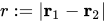


Note that when and this becomes the Lennard-Jones model.


(14,7) model
- Afshin Eskandari Nasrabad "Monte Carlo simulations of thermodynamic and structural properties of Mie(14,7) fluids", Journal of Chemical Physics 128 154514 (2008)
- Afshin Eskandari Nasrabad, Nader Mansoori Oghaz, and Behzad Haghighi "Transport properties of Mie(14,7) fluids: Molecular dynamics simulation and theory", Journal of Chemical Physics 129 024507 (2008)