Soft sphere potential: Difference between revisions
Jump to navigation
Jump to search
Carl McBride (talk | contribs) m (Added a reference.) |
m (Added another reference.) |
||
| Line 7: | Line 7: | ||
</math> | </math> | ||
where <math> \Phi_{12}\left(r \right) </math> is the [[intermolecular pair potential]] between two soft spheres separated by a distance <math>r := |\mathbf{r}_1 - \mathbf{r}_2|</math>, <math>\epsilon </math>is the interaction strength and <math> \sigma </math> is the diameter of the sphere. Frequently the value of <math>n</math> is taken to be 12, thus the model becomes the high temperature limit of the [[Lennard-Jones model]] | where <math> \Phi_{12}\left(r \right) </math> is the [[intermolecular pair potential]] between two soft spheres separated by a distance <math>r := |\mathbf{r}_1 - \mathbf{r}_2|</math>, <math>\epsilon </math>is the interaction strength and <math> \sigma </math> is the diameter of the sphere. Frequently the value of <math>n</math> is taken to be 12, thus the model becomes the high temperature limit of the [[Lennard-Jones model]] <ref>[http://dx.doi.org/10.1103/PhysRevA.2.221 Jean-Pierre Hansen "Phase Transition of the Lennard-Jones System. II. High-Temperature Limit", Physical Review A '''2''' pp. 221-230 (1970)]</ref> | ||
==References== | ==References== | ||
<references/> | <references/> | ||
''' | '''Related reading''' | ||
*[http://dx.doi.org/10.1063/1.1672728 William G. Hoover, Marvin Ross, Keith W. Johnson, Douglas Henderson, John A. Barker and Bryan C. Brown "Soft-Sphere Equation of State", Journal of Chemical Physics '''52''' pp. 4931-4941 (1970)] | *[http://dx.doi.org/10.1063/1.1672728 William G. Hoover, Marvin Ross, Keith W. Johnson, Douglas Henderson, John A. Barker and Bryan C. Brown "Soft-Sphere Equation of State", Journal of Chemical Physics '''52''' pp. 4931-4941 (1970)] | ||
[[category: models]] | [[category: models]] | ||
Revision as of 15:04, 12 May 2009
The soft sphere potential intermolecular pair potential is defined as
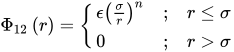
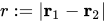
where is the intermolecular pair potential between two soft spheres separated by a distance , is the interaction strength and is the diameter of the sphere. Frequently the value of is taken to be 12, thus the model becomes the high temperature limit of the Lennard-Jones model [1]



References
Related reading