Reverse Monte Carlo
Reverse Monte Carlo (RMC) [1] is a variation of the standard Metropolis Monte Carlo (MMC) method. It is used to produce a 3 dimensional atomic model that fits a set of measurements (Neutron-, X-ray-diffraction, EXAFS etc.). In addition to measured data a number of constraints based on prior knowledge of the system (like chemocal bonds etc.) can be applied. Some examples are:
- Closest approach between atoms (hard sphere potential)
- Coordination numbers.
- Angels in triplets of atoms.
The algorithm for RMC can be written:
- Start with a configuration of atoms with periodic boundary conditions. This can be a random or a crystalline configuration from a different simulation or model.
- Calculate the total radial distribution function for this old configuration.
- Transform to the total structure factor:

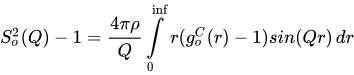
where Q is the momentum transfer and the number density.

- Calculate the difference between the measured structure factor and the one calculated from the configuration :



this sum is taken over all experimental points is the experimental error.

- Select and move one atom at random and calculate the new distribution function, structure factor and:
Failed to parse (SVG (MathML can be enabled via browser plugin): Invalid response ("Math extension cannot connect to Restbase.") from server "https://wikimedia.org/api/rest_v1/":): {\displaystyle \chi_n^2=\sum_i(S_n^C(Q_i)-S^E(Q_i))^2/\sigma(Q_i)^2}
References
- R.L.McGreevy and L. Pusztai, Mol. Simulation, 1 359-367 (1988)