Hard ellipsoid model

Interaction Potential
The general ellipsoid, also called a triaxial ellipsoid, is a quadratic surface which is given in Cartesian coordinates by
- Failed to parse (SVG (MathML can be enabled via browser plugin): Invalid response ("Math extension cannot connect to Restbase.") from server "https://wikimedia.org/api/rest_v1/":): {\displaystyle \frac{x^2}{a^2} + \frac{y^2}{b^2} + \frac{z^2}{c^2} = 1}
where Failed to parse (SVG (MathML can be enabled via browser plugin): Invalid response ("Math extension cannot connect to Restbase.") from server "https://wikimedia.org/api/rest_v1/":): {\displaystyle a} , Failed to parse (SVG (MathML can be enabled via browser plugin): Invalid response ("Math extension cannot connect to Restbase.") from server "https://wikimedia.org/api/rest_v1/":): {\displaystyle b } and Failed to parse (SVG (MathML can be enabled via browser plugin): Invalid response ("Math extension cannot connect to Restbase.") from server "https://wikimedia.org/api/rest_v1/":): {\displaystyle c} define the lengths of the axis.
Overlap algorithm
The most widely used overlap algorithm is that of Perram and Wertheim:
Geometric properties
The mean radius of curvature is given by (Ref. 2)
- Failed to parse (SVG (MathML can be enabled via browser plugin): Invalid response ("Math extension cannot connect to Restbase.") from server "https://wikimedia.org/api/rest_v1/":): {\displaystyle R= \frac{a}{2} \left[ \sqrt{\frac{1+\epsilon_b}{1+\epsilon_c}} + \sqrt \epsilon_c \left\{ \frac{1}{\epsilon_c} F(\varphi , k_1) + E(\varphi,k_1) \right\}\right], }
and the surface area is given by
- Failed to parse (SVG (MathML can be enabled via browser plugin): Invalid response ("Math extension cannot connect to Restbase.") from server "https://wikimedia.org/api/rest_v1/":): {\displaystyle S= 2 \pi a^2 \left[ 1+ \sqrt {\epsilon_c(1+\epsilon_b)} \left\{ \frac{1}{\epsilon_c} F(\varphi , k_2) + E(\varphi,k_2)\right\} \right], }
where Failed to parse (SVG (MathML can be enabled via browser plugin): Invalid response ("Math extension cannot connect to Restbase.") from server "https://wikimedia.org/api/rest_v1/":): {\displaystyle F(\varphi,k)} is an elliptic integral of the first kind and Failed to parse (SVG (MathML can be enabled via browser plugin): Invalid response ("Math extension cannot connect to Restbase.") from server "https://wikimedia.org/api/rest_v1/":): {\displaystyle E(\varphi,k)} is an elliptic integral of the second kind, with the amplitude being
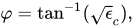
and the moduli
- Failed to parse (SVG (MathML can be enabled via browser plugin): Invalid response ("Math extension cannot connect to Restbase.") from server "https://wikimedia.org/api/rest_v1/":): {\displaystyle k_1= \sqrt{\frac{\epsilon_c-\epsilon_b}{\epsilon_c}},}
and
- Failed to parse (SVG (MathML can be enabled via browser plugin): Invalid response ("Math extension cannot connect to Restbase.") from server "https://wikimedia.org/api/rest_v1/":): {\displaystyle k_2= \sqrt{\frac{\epsilon_b (1+\epsilon_c)}{\epsilon_c(1+\epsilon_b)}},}
where the anisotropy parameters, Failed to parse (SVG (MathML can be enabled via browser plugin): Invalid response ("Math extension cannot connect to Restbase.") from server "https://wikimedia.org/api/rest_v1/":): {\displaystyle \epsilon_b} and Failed to parse (SVG (MathML can be enabled via browser plugin): Invalid response ("Math extension cannot connect to Restbase.") from server "https://wikimedia.org/api/rest_v1/":): {\displaystyle \epsilon_c} , are
- Failed to parse (SVG (MathML can be enabled via browser plugin): Invalid response ("Math extension cannot connect to Restbase.") from server "https://wikimedia.org/api/rest_v1/":): {\displaystyle \epsilon_b = \left( \frac{b}{a} \right)^2 -1,}
and
- Failed to parse (SVG (MathML can be enabled via browser plugin): Invalid response ("Math extension cannot connect to Restbase.") from server "https://wikimedia.org/api/rest_v1/":): {\displaystyle \epsilon_c = \left( \frac{c}{a} \right)^2 -1.}
The volume of the ellipsoid is given by the well known
- Failed to parse (SVG (MathML can be enabled via browser plugin): Invalid response ("Math extension cannot connect to Restbase.") from server "https://wikimedia.org/api/rest_v1/":): {\displaystyle V = \frac{4 \pi}{3}abc.}