Grand canonical ensemble
The grand-canonical ensemble is particularly well suited to simulation studies of adsorption.
Ensemble variables

- Volume,

- Temperature,

Partition Function
The classical grand canonical partition function for a one-component system in a three-dimensional space is given by:
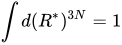
![{\displaystyle Q_{\mu VT}=\sum _{N=0}^{\infty }{\frac {\exp \left[\beta \mu N\right]V^{N}}{N!\Lambda ^{3N}}}\int d(R^{*})^{3N}\exp \left[-\beta U\left(V,(R^{*})^{3N}\right)\right]}](https://wikimedia.org/api/rest_v1/media/math/render/svg/d47556ad6dddaae0f31b5b97afd881e5dae0724a)
where:
- is the number of particles

- is the de Broglie thermal wavelength (which depends on the temperature)

- , with being the Boltzmann constant


- U is the potential energy, which depends on the coordinates of the particles (and on the interaction model)
- represent the position coordinates of the particles (reduced with the system size): i.e.


Helmholtz energy and partition function
The corresponding thermodynamic potential, the grand potential, , for the grand canonical partition function is:

- ,
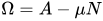
where A is the Helmholtz energy function. Using the relation

one arrives at

i.e.:
