Square shoulder + square well model
The Square shoulder + square well model consists, as its name suggests, of a combination of the square shoulder model and the square well model. The model is given by
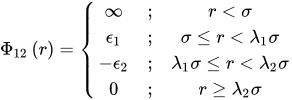
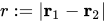
where is the intermolecular pair potential, and are the well depths, is the distance between site 1 and site 2 where , σ is the hard core diameter and



Liquid-liquid transition
For certain parameter sets the square shoulder + square well model has a liquid-liquid transition along with a corresponding liquid-liquid critical point [1] [2] [3] [4].
References
- ↑ Giancarlo Franzese, Gianpietro Malescio, Anna Skibinsky, Sergey V. Buldyrev, and H. Eugene Stanley "Generic mechanism for generating a liquid-liquid phase transition", Nature 409 pp. 692-695 (2001)
- ↑ Giancarlo Franzese, Gianpietro Malescio, Anna Skibinsky, Sergey V. Buldyrev, and H. Eugene Stanley, "Metstable liquid-liquid phase transition in a single-component system with only one crystal phase and no density anomaly", Physical Review E 66 051206 (2002)
- ↑ Anna Skibinsky, Sergey V. Buldyrev, Giancarlo Franzese, Gianpietro Malescio, and H. Eugene Stanley, "Liquid-liquid phase transitions for soft-core attractive potentials", Physical Review E 69 061206 (2004)
- ↑ Gianpietro Malescio, Giancarlo Franzese, Anna Skibinsky, Sergey V. Buldyrev, and H. Eugene Stanley, "Liquid-liquid phase transition for an attractive isotropic potential with wide repulsive range", Physical Review E 71 061504 (2005)
- Related reading
- Andreas Lang, Gerhard Kahl, Christos N Likos, Hartmut Löwen and Martin Watzlawek "Structure and thermodynamics of square-well and square-shoulder fluids", Journal of Physics: Condensed Matter 11 pp. 10143-10161 (1999)
- W. Rzysko, O. Pizio, A. Patrykiejew, and S. Sokolowski "Phase diagram of a square-shoulder, square-well fluid revisited", Journal of Chemical Physics 129 124502 (2008)
- Shiqi Zhou, A. Lajovic, and A. Jamnik "Local structures of fluid with discrete spherical potential: Theory and grand canonical ensemble Monte Carlo simulation", Journal of Chemical Physics 129 124503 (2008)