Grand canonical ensemble
The grand-canonical ensemble is for "open" systems, where the number of particles, , can change. It can be viewed as an ensemble of canonical ensembles; there being a canonical ensemble for each value of , and the (weighted) sum over of these canonical ensembles constitutes the grand canonical ensemble. The weighting factor is and is known as the fugacity. The grand-canonical ensemble is particularly well suited to simulation studies of adsorption.

![{\displaystyle \exp \left[\beta \mu \right]}](https://wikimedia.org/api/rest_v1/media/math/render/svg/2ee894e58e3416f71930628e1b50c7ac1aa832e3)
Ensemble variables
- chemical potential,
- volume,
- temperature,


Grand canonical partition function
The grand canonical partition function for a one-component system in a three-dimensional space is given by:
![{\displaystyle \Xi _{\mu VT}=\sum _{N=0}^{\infty }\exp \left[\beta \mu N\right]Q_{NVT}}](https://wikimedia.org/api/rest_v1/media/math/render/svg/ef904e42cf93b2f11bcec2757385884620f8c7a4)
where represents the canonical ensemble partition function. For example, for a classical system one has

![{\displaystyle \Xi _{\mu VT}=\sum _{N=0}^{\infty }\exp \left[\beta \mu N\right]{\frac {V^{N}}{N!\Lambda ^{3N}}}\int d(R^{*})^{3N}\exp \left[-\beta U\left(V,(R^{*})^{3N}\right)\right]}](https://wikimedia.org/api/rest_v1/media/math/render/svg/2918a47c2ede5c1cc4f906029ca17adbff6daac9)
where:
- is the number of particles
- is the de Broglie thermal wavelength (which depends on the temperature)
- is the inverse temperature
- is the potential energy, which depends on the coordinates of the particles (and on the interaction model)
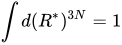
- represent the position coordinates of the particles (reduced with the system size): i.e.


Helmholtz energy and partition function
The corresponding thermodynamic potential, the grand potential, , for the aforementioned grand canonical partition function is:

- ,
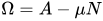
where A is the Helmholtz energy function. Using the relation

one arrives at

i.e.:
- Failed to parse (SVG (MathML can be enabled via browser plugin): Invalid response ("Math extension cannot connect to Restbase.") from server "https://wikimedia.org/api/rest_v1/":): {\displaystyle \left. p V = k_B T \ln \Xi_{\mu V T } \right. }
See also
References
- Related reading