Structure factor
The static structure factor, , for a monatomic system composed of spherical scatterers is defined by (Eq. 1 in [1]):


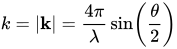
where is the radial distribution function, and is the scattering wave-vector modulus


- .
The structure factor is basically a Fourier transform of the pair distribution function ,


At zero wavenumber, i.e. ,

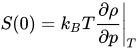
from which one can calculate the isothermal compressibility.
To calculate Failed to parse (SVG (MathML can be enabled via browser plugin): Invalid response ("Math extension cannot connect to Restbase.") from server "https://wikimedia.org/api/rest_v1/":): {\displaystyle S(k)} in molecular simulations one typically uses:
- Failed to parse (SVG (MathML can be enabled via browser plugin): Invalid response ("Math extension cannot connect to Restbase.") from server "https://wikimedia.org/api/rest_v1/":): {\displaystyle S(k) = \frac{1}{N} \sum^{N}_{n,m=1} \langle\exp(-i\mathbf{k}(\mathbf{r}_n-\mathbf{r}_m)) \rangle } ,
where Failed to parse (SVG (MathML can be enabled via browser plugin): Invalid response ("Math extension cannot connect to Restbase.") from server "https://wikimedia.org/api/rest_v1/":): {\displaystyle N} is the number of particles and Failed to parse (SVG (MathML can be enabled via browser plugin): Invalid response ("Math extension cannot connect to Restbase.") from server "https://wikimedia.org/api/rest_v1/":): {\displaystyle \mathbf{r}_n} and are the coordinates of particles Failed to parse (SVG (MathML can be enabled via browser plugin): Invalid response ("Math extension cannot connect to Restbase.") from server "https://wikimedia.org/api/rest_v1/":): {\displaystyle n} and Failed to parse (SVG (MathML can be enabled via browser plugin): Invalid response ("Math extension cannot connect to Restbase.") from server "https://wikimedia.org/api/rest_v1/":): {\displaystyle m} respectively.

The dynamic, time dependent structure factor is defined as follows:
- Failed to parse (SVG (MathML can be enabled via browser plugin): Invalid response ("Math extension cannot connect to Restbase.") from server "https://wikimedia.org/api/rest_v1/":): {\displaystyle S(k,t) = \frac{1}{N} \sum^{N}_{n,m=1} \langle \exp(-i\mathbf{k}(\mathbf{r}_n(t)-\mathbf{r}_m(0))) \rangle } ,
The ratio between the dynamic and the static structure factor, Failed to parse (SVG (MathML can be enabled via browser plugin): Invalid response ("Math extension cannot connect to Restbase.") from server "https://wikimedia.org/api/rest_v1/":): {\displaystyle S(k,t)/S(k,0)} , is known as the collective (or coherent) intermediate scattering function.
Binary mixtures
References
- ↑ A. Filipponi, "The radial distribution function probed by X-ray absorption spectroscopy", Journal of Physics: Condensed Matter 6 pp. 8415-8427 (1994)
- ↑ T. E. Faber and J. M. Ziman "A theory of the electrical properties of liquid metals III. the resistivity of binary alloys", Philosophical Magazine 11 pp. 153-173 (1965)
- ↑ N. W. Ashcroft and David C. Langreth "Structure of Binary Liquid Mixtures. I", Physical Review 156 pp. 685–692 (1967)
- ↑ A. B. Bhatia and D. E. Thornton "Structural Aspects of the Electrical Resistivity of Binary Alloys", Physical Review B 2 pp. 3004-3012 (1970)
- Related reading
- F. Zernike and J. A. Prins "Die Beugung von Röntgenstrahlen in Flüssigkeiten als Effekt der Molekülanordnung", Zeitschrift für Physik 41 pp. 184-194 (1920)
- P. Debye and H. Menke "", Physik. Zeits. 31 pp. 348- (1930)
- B. E. Warren "X-Ray Diffraction", Dover Publications (1969) ISBN 0486663175 § 10.4
- Jean-Pierre Hansen and I.R. McDonald "Theory of Simple Liquids" (Third Edition) Chapter 4: "Distribution-function Theories" § 4.1