Weeks-Chandler-Andersen perturbation theory

From SklogWiki
Revision as of 16:40, 20 June 2007 by Carl McBride (talk | contribs) (New page: The '''Weeks-Chandler-Anderson perturbation theory''' is based on the following decomposition of the intermolecular pair potential (in particular, the [[Lennard-Jones model | Lennard-J...)
(diff) ← Older revision | Latest revision (diff) | Newer revision → (diff)
Jump to navigation Jump to search

The Weeks-Chandler-Anderson perturbation theory is based on the following decomposition of the intermolecular pair potential (in particular, the Lennard-Jones potential ):

The reference system pair potential is given by (Eq, 4 Ref. 1):

Failed to parse (Conversion error. Server ("https://wikimedia.org/api/rest_") reported: "Cannot get mml. Server problem."): {\displaystyle u_{\rm {repulsive}}(r)=\left\{{\begin{array}{ll}u_{\rm {LJ}}(r)+\epsilon &{\rm {if}}\;r<2^{1/6}\sigma \\0&{\rm {if}}\;r\geq 2^{1/6}\sigma \end{array}}\right.}

and the perturbation potential is given by (Eq, 5 Ref. 1):
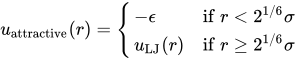
Failed to parse (Conversion error. Server ("https://wikimedia.org/api/rest_") reported: "Cannot get mml. Server problem."): {\displaystyle u_{\rm {attractive}}(r)=\left\{{\begin{array}{ll}-\epsilon &{\rm {if}}\;r<2^{1/6}\sigma \\u_{\rm {LJ}}(r)&{\rm {if}}\;r\geq 2^{1/6}\sigma \end{array}}\right.}

References

  1. John D. Weeks, David Chandler and Hans C. Andersen "Role of Repulsive Forces in Determining the Equilibrium Structure of Simple Liquids", Journal of Chemical Physics 54 pp. 5237-5247 (1971)