Kelvin equation
The Kelvin equation is used to calculate the onset/occurrence of capillary condensation
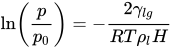
- Failed to parse (SVG (MathML can be enabled via browser plugin): Invalid response ("Math extension cannot connect to Restbase.") from server "https://wikimedia.org/api/rest_v1/":): {\displaystyle \ln \left( \frac{p}{p_0}\right) = - \frac{2\gamma_{lg}}{RT\rho_lH}}
Where p is the pressure, Failed to parse (SVG (MathML can be enabled via browser plugin): Invalid response ("Math extension cannot connect to Restbase.") from server "https://wikimedia.org/api/rest_v1/":): {\displaystyle p_0} is the saturated vapour pressure, is the liquid-gas surface tension for the bulk fluid, Failed to parse (SVG (MathML can be enabled via browser plugin): Invalid response ("Math extension cannot connect to Restbase.") from server "https://wikimedia.org/api/rest_v1/":): {\displaystyle \rho_l} is the density of the bulk fluid, R is the universal gas constant, T is the temperature and H is the pore or capillary width.