Canonical ensemble

From SklogWiki
Revision as of 18:59, 22 February 2007 by Carl McBride (talk | contribs)
Jump to navigation Jump to search

Canonical Ensemble:

Variables:

  • Number of Particles,
  • Volume,
  • Temperature,

Partition Function

Classical Partition Function (one-component system) in a three-dimensional space:

Failed to parse (Conversion error. Server ("https://wikimedia.org/api/rest_") reported: "Cannot get mml. Server problem."): {\displaystyle Q_{NVT}={\frac {V^{N}}{N!\Lambda ^{3N}}}\int d(R^{*})^{3N}\exp \left[-\beta U\left(V,(R^{*})^{3N}\right)\right]}

where:

  • Failed to parse (Conversion error. Server ("https://wikimedia.org/api/rest_") reported: "Cannot get mml. Server problem."): {\displaystyle \beta ={\frac {1}{k_{B}T}}} , with being the Boltzmann constant
  • is the potential energy, which depends on the coordinates of the particles (and on the interaction model)
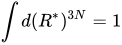
  • Failed to parse (Conversion error. Server ("https://wikimedia.org/api/rest_") reported: "Cannot get mml. Server problem."): {\displaystyle \left(R^{*}\right)^{3N}} represent the 3N position coordinates of the particles (reduced with the system size): i.e. Failed to parse (SVG (MathML can be enabled via browser plugin): Invalid response ("Math extension cannot connect to Restbase.") from server "https://wikimedia.org/api/rest_v1/":): {\displaystyle \int d (R^*)^{3N} = 1 }

Free energy and Partition Function

The Helmholtz energy function is related to the canonical partition function via:

Failed to parse (SVG (MathML can be enabled via browser plugin): Invalid response ("Math extension cannot connect to Restbase.") from server "https://wikimedia.org/api/rest_v1/":): {\displaystyle A\left(N,V,T \right) = - k_B T \log Q_{NVT} }