1-dimensional hard rods
1-dimensional hard rods (sometimes known as a Tonks gas [1]) consist of non-overlapping line segments of length Failed to parse (SVG (MathML can be enabled via browser plugin): Invalid response ("Math extension cannot connect to Restbase.") from server "https://wikimedia.org/api/rest_v1/":): {\displaystyle \sigma} who all occupy the same line which has length Failed to parse (SVG (MathML can be enabled via browser plugin): Invalid response ("Math extension cannot connect to Restbase.") from server "https://wikimedia.org/api/rest_v1/":): {\displaystyle L} . One could also think of this model as being a string of hard spheres confined to 1 dimension (not to be confused with 3-dimensional hard rods). The model is given by the intermolecular pair potential:
- Failed to parse (SVG (MathML can be enabled via browser plugin): Invalid response ("Math extension cannot connect to Restbase.") from server "https://wikimedia.org/api/rest_v1/":): {\displaystyle \Phi_{12}(x_{i},x_{j})=\left\{ \begin{array}{lll} 0 & ; & |x_{i}-x_{j}|>\sigma\\ \infty & ; & |x_{i}-x_{j}|<\sigma \end{array}\right. }
where Failed to parse (SVG (MathML can be enabled via browser plugin): Invalid response ("Math extension cannot connect to Restbase.") from server "https://wikimedia.org/api/rest_v1/":): {\displaystyle \left. x_k \right. } is the position of the center of the k-th rod, along with an external potential. Thus, the Boltzmann factor is
- Failed to parse (SVG (MathML can be enabled via browser plugin): Invalid response ("Math extension cannot connect to Restbase.") from server "https://wikimedia.org/api/rest_v1/":): {\displaystyle e_{ij}:=e^{-\beta\Phi_{12}(x_{i},x_{j})}=\Theta(|x_{i}-x_{j}|-\sigma)=\left\{ \begin{array}{lll} 1 & ; & |x_{i}-x_{j}|>\sigma\\ 0 & ; & |x_{i}-x_{j}|<\sigma \end{array}\right. }
The whole length of the rod must be inside the range:
- Failed to parse (SVG (MathML can be enabled via browser plugin): Invalid response ("Math extension cannot connect to Restbase.") from server "https://wikimedia.org/api/rest_v1/":): {\displaystyle V_{0}(x_i) = \left\{ \begin{array}{lll} 0 & ; & \sigma/2 < x_i < L - \sigma/2 \\ \infty &; & {\mathrm {elsewhere}}. \end{array} \right. }
Canonical Ensemble: Configuration Integral[edit]
The statistical mechanics of this system can be solved exactly. Consider a system of length Failed to parse (SVG (MathML can be enabled via browser plugin): Invalid response ("Math extension cannot connect to Restbase.") from server "https://wikimedia.org/api/rest_v1/":): {\displaystyle \left. L \right. } defined in the range Failed to parse (SVG (MathML can be enabled via browser plugin): Invalid response ("Math extension cannot connect to Restbase.") from server "https://wikimedia.org/api/rest_v1/":): {\displaystyle \left[ 0, L \right] } . The aim is to compute the partition function of a system of hard rods of length Failed to parse (SVG (MathML can be enabled via browser plugin): Invalid response ("Math extension cannot connect to Restbase.") from server "https://wikimedia.org/api/rest_v1/":): {\displaystyle \left. \sigma \right. } . Consider that the particles are ordered according to their label: Failed to parse (SVG (MathML can be enabled via browser plugin): Invalid response ("Math extension cannot connect to Restbase.") from server "https://wikimedia.org/api/rest_v1/":): {\displaystyle x_0 < x_1 < x_2 < \cdots < x_{N-1} } ; taking into account the pair potential we can write the canonical partition function of a system of Failed to parse (SVG (MathML can be enabled via browser plugin): Invalid response ("Math extension cannot connect to Restbase.") from server "https://wikimedia.org/api/rest_v1/":): {\displaystyle N } particles as:

- Failed to parse (SVG (MathML can be enabled via browser plugin): Invalid response ("Math extension cannot connect to Restbase.") from server "https://wikimedia.org/api/rest_v1/":): {\displaystyle \begin{align} \frac{Z\left(N,L\right)}{N!} & =\int_{\sigma/2}^{L-\sigma/2}dx_{0}\int_{\sigma/2}^{L-\sigma/2}dx_{1}\cdots\int_{\sigma/2}^{L-\sigma/2}dx_{N-1}\prod_{i=1}^{N-1}e_{i-1,i}\\ & =\int_{\sigma/2}^{L+\sigma/2-N\sigma}dx_{0}\int_{x_{0}+\sigma}^{L+\sigma/2-N\sigma+\sigma}dx_{1}\cdots\int_{x_{i-1}+\sigma}^{L+\sigma/2-N\sigma+i\sigma}dx_{i}\cdots\int_{x_{N-2}+\sigma}^{L+\sigma/2-N\sigma+(N-1)\sigma}dx_{N-1}. \end{align}}
Variable change: ; we get:
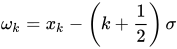
- Failed to parse (SVG (MathML can be enabled via browser plugin): Invalid response ("Math extension cannot connect to Restbase.") from server "https://wikimedia.org/api/rest_v1/":): {\displaystyle \begin{align} \frac{Z\left(N,L\right)}{N!} & =\int_{0}^{L-N\sigma}d\omega_{0}\int_{\omega_{0}}^{L-N\sigma}d\omega_{1}\cdots\int_{\omega_{i-1}}^{L-N\sigma}d\omega_{i}\cdots\int_{\omega_{N-2}}^{L-N\sigma}d\omega_{N-1}\\ & =\int_{0}^{L-N\sigma}d\omega_{0}\cdots\int_{\omega_{i-1}}^{L-N\sigma}d\omega_{i}\frac{(L-N\sigma-\omega_{i})^{N-1-i}}{(N-1-i)!}=\int_{0}^{L-N\sigma}d\omega_{0}\frac{(L-N\sigma-\omega_{0})^{N-1}}{(N-1)!} \end{align}}
Therefore:
- Failed to parse (SVG (MathML can be enabled via browser plugin): Invalid response ("Math extension cannot connect to Restbase.") from server "https://wikimedia.org/api/rest_v1/":): {\displaystyle \frac{ Z \left( N,L \right)}{N!} = \frac{ (L-N\sigma )^{N} }{N!}. }
- Failed to parse (SVG (MathML can be enabled via browser plugin): Invalid response ("Math extension cannot connect to Restbase.") from server "https://wikimedia.org/api/rest_v1/":): {\displaystyle Q(N,L) = \frac{ (L-N \sigma )^N}{\Lambda^N N!}. }
Thermodynamics[edit]
- Failed to parse (SVG (MathML can be enabled via browser plugin): Invalid response ("Math extension cannot connect to Restbase.") from server "https://wikimedia.org/api/rest_v1/":): {\displaystyle \left. A(N,L,T) = - k_B T \log Q \right. }
In the thermodynamic limit (i.e. with Failed to parse (SVG (MathML can be enabled via browser plugin): Invalid response ("Math extension cannot connect to Restbase.") from server "https://wikimedia.org/api/rest_v1/":): {\displaystyle \rho = \frac{N}{L} } , remaining finite):

- Failed to parse (SVG (MathML can be enabled via browser plugin): Invalid response ("Math extension cannot connect to Restbase.") from server "https://wikimedia.org/api/rest_v1/":): {\displaystyle A \left( N,L,T \right) = N k_B T \left[ \log \left( \frac{ N \Lambda} { L - N \sigma }\right) - 1 \right]. }
Equation of state[edit]
Using the thermodynamic relations, the pressure (linear tension in this case) Failed to parse (SVG (MathML can be enabled via browser plugin): Invalid response ("Math extension cannot connect to Restbase.") from server "https://wikimedia.org/api/rest_v1/":): {\displaystyle \left. p \right. } can be written as:
- Failed to parse (SVG (MathML can be enabled via browser plugin): Invalid response ("Math extension cannot connect to Restbase.") from server "https://wikimedia.org/api/rest_v1/":): {\displaystyle p = - \left( \frac{ \partial A}{\partial L} \right)_{N,T} = \frac{ N k_B T}{L - N \sigma}; }
The compressibility factor is
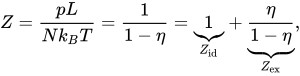
where Failed to parse (SVG (MathML can be enabled via browser plugin): Invalid response ("Math extension cannot connect to Restbase.") from server "https://wikimedia.org/api/rest_v1/":): {\displaystyle \eta \equiv \frac{ N \sigma}{L} } ; is the fraction of volume (i.e. length) occupied by the rods. 'id' labels the ideal and 'ex' the excess part.
It was shown by van Hove [2] that there is no fluid-solid phase transition for this system (hence the designation Tonks gas).
Chemical potential[edit]
The chemical potential is given by
- Failed to parse (SVG (MathML can be enabled via browser plugin): Invalid response ("Math extension cannot connect to Restbase.") from server "https://wikimedia.org/api/rest_v1/":): {\displaystyle \mu=\left(\frac{\partial A}{\partial N}\right)_{L,T}=k_{B}T\left(\ln\frac{\rho\Lambda}{1-\rho\sigma}+\frac{\rho\sigma}{1-\rho\sigma}\right)=k_{B}T\left(\ln\frac{\rho\Lambda}{1-\eta}+\frac{\eta}{1-\eta}\right) }
with ideal and excess part separated:
- Failed to parse (SVG (MathML can be enabled via browser plugin): Invalid response ("Math extension cannot connect to Restbase.") from server "https://wikimedia.org/api/rest_v1/":): {\displaystyle \beta\mu=\underbrace{\ln(\rho\Lambda)}_{\beta\mu_{\mathrm{id}}}+\underbrace{\ln\frac{1}{1-\eta}+\frac{\eta}{1-\eta}}_{\beta\mu_{\mathrm{ex}}} }
Isobaric ensemble: an alternative derivation[edit]
Adapted from Reference [3]. If the rods are ordered according to their label: Failed to parse (SVG (MathML can be enabled via browser plugin): Invalid response ("Math extension cannot connect to Restbase.") from server "https://wikimedia.org/api/rest_v1/":): {\displaystyle x_0 < x_1 < x_2 < \cdots < x_{N-1} } the canonical partition function can also be written as:

where Failed to parse (SVG (MathML can be enabled via browser plugin): Invalid response ("Math extension cannot connect to Restbase.") from server "https://wikimedia.org/api/rest_v1/":): {\displaystyle N!} does not appear one would have Failed to parse (SVG (MathML can be enabled via browser plugin): Invalid response ("Math extension cannot connect to Restbase.") from server "https://wikimedia.org/api/rest_v1/":): {\displaystyle N!} analogous expressions by permuting the label of the (distinguishable) rods. is the Boltzmann factor of the hard rods, which is Failed to parse (SVG (MathML can be enabled via browser plugin): Invalid response ("Math extension cannot connect to Restbase.") from server "https://wikimedia.org/api/rest_v1/":): {\displaystyle 0} if Failed to parse (SVG (MathML can be enabled via browser plugin): Invalid response ("Math extension cannot connect to Restbase.") from server "https://wikimedia.org/api/rest_v1/":): {\displaystyle x<\sigma} and Failed to parse (SVG (MathML can be enabled via browser plugin): Invalid response ("Math extension cannot connect to Restbase.") from server "https://wikimedia.org/api/rest_v1/":): {\displaystyle 1} otherwise.

A variable change to the distances between rods: Failed to parse (SVG (MathML can be enabled via browser plugin): Invalid response ("Math extension cannot connect to Restbase.") from server "https://wikimedia.org/api/rest_v1/":): {\displaystyle y_k = x_k - x_{k-1} } results in

the distances can take any value as long as they are not below Failed to parse (SVG (MathML can be enabled via browser plugin): Invalid response ("Math extension cannot connect to Restbase.") from server "https://wikimedia.org/api/rest_v1/":): {\displaystyle \sigma} (as enforced by Failed to parse (SVG (MathML can be enabled via browser plugin): Invalid response ("Math extension cannot connect to Restbase.") from server "https://wikimedia.org/api/rest_v1/":): {\displaystyle f(y)} ) and as long as they add up to Failed to parse (SVG (MathML can be enabled via browser plugin): Invalid response ("Math extension cannot connect to Restbase.") from server "https://wikimedia.org/api/rest_v1/":): {\displaystyle L} (as enforced by the Dirac delta). Writing the later as the inverse Laplace transform of an exponential:
- Failed to parse (SVG (MathML can be enabled via browser plugin): Invalid response ("Math extension cannot connect to Restbase.") from server "https://wikimedia.org/api/rest_v1/":): {\displaystyle Z = \int_0^{\infty} d y_0 \int_0^{\infty} d y_1 \cdots \int_0^{\infty} d y_{N-1} f(y_0) f(y_1) \cdots f(y_{N-1}) \frac{1}{2\pi i } \int_{-\infty}^{\infty} ds \exp \left[ - s \left(\sum_{i=0}^{N-1} y_i-L \right)\right]. }
Exchanging integrals and expanding the exponential the Failed to parse (SVG (MathML can be enabled via browser plugin): Invalid response ("Math extension cannot connect to Restbase.") from server "https://wikimedia.org/api/rest_v1/":): {\displaystyle N} integrals decouple:
- Failed to parse (SVG (MathML can be enabled via browser plugin): Invalid response ("Math extension cannot connect to Restbase.") from server "https://wikimedia.org/api/rest_v1/":): {\displaystyle Z = \frac{1}{2\pi i } \int_{-\infty}^{\infty} ds e^{ L s } \left\{ \int_0^{\infty} d y f(y) e^{ - s y } \right\}^N. }
We may proceed to invert the Laplace transform (e.g. by means of the residues theorem), but this is not needed: we see our configuration integral is the inverse Laplace transform of another one,
- Failed to parse (SVG (MathML can be enabled via browser plugin): Invalid response ("Math extension cannot connect to Restbase.") from server "https://wikimedia.org/api/rest_v1/":): {\displaystyle Z'(s)= \left\{ \int_0^{\infty} d y f(y) e^{ - s y } \right\}^N, }
so that
- Failed to parse (SVG (MathML can be enabled via browser plugin): Invalid response ("Math extension cannot connect to Restbase.") from server "https://wikimedia.org/api/rest_v1/":): {\displaystyle Z'(s) = \int_0^{\infty} ds e^{ L s } Z(L). }
This is precisely the transformation from the configuration integral in the canonical (Failed to parse (SVG (MathML can be enabled via browser plugin): Invalid response ("Math extension cannot connect to Restbase.") from server "https://wikimedia.org/api/rest_v1/":): {\displaystyle N,T,L} ) ensemble to the isobaric (Failed to parse (SVG (MathML can be enabled via browser plugin): Invalid response ("Math extension cannot connect to Restbase.") from server "https://wikimedia.org/api/rest_v1/":): {\displaystyle N,T,p} ) one, if one identifies . Therefore, the Gibbs energy function is simply Failed to parse (SVG (MathML can be enabled via browser plugin): Invalid response ("Math extension cannot connect to Restbase.") from server "https://wikimedia.org/api/rest_v1/":): {\displaystyle G=-kT\log Z'(p/kT) } , which easily evaluated to be Failed to parse (SVG (MathML can be enabled via browser plugin): Invalid response ("Math extension cannot connect to Restbase.") from server "https://wikimedia.org/api/rest_v1/":): {\displaystyle G=kT N \log(p/kT)+p\sigma N} . The chemical potential is Failed to parse (SVG (MathML can be enabled via browser plugin): Invalid response ("Math extension cannot connect to Restbase.") from server "https://wikimedia.org/api/rest_v1/":): {\displaystyle \mu=G/N} , and by means of thermodynamic identities such as Failed to parse (SVG (MathML can be enabled via browser plugin): Invalid response ("Math extension cannot connect to Restbase.") from server "https://wikimedia.org/api/rest_v1/":): {\displaystyle \rho=\partial p/\partial \mu} one arrives at the same equation of state as the one given above.

Confined hard rods[edit]
References[edit]
- ↑ Lewi Tonks "The Complete Equation of State of One, Two and Three-Dimensional Gases of Hard Elastic Spheres", Physical Review 50 pp. 955- (1936)
- ↑ L. van Hove, "Sur L'intégrale de Configuration Pour Les Systèmes De Particules À Une Dimension", Physica, 16 pp. 137-143 (1950)
- ↑ J. M. Ziman Models of Disorder: The Theoretical Physics of Homogeneously Disordered Systems, Cambridge University Press (1979) ISBN 0521292808
- ↑ A. Robledo and J. S. Rowlinson "The distribution of hard rods on a line of finite length", Molecular Physics 58 pp. 711-721 (1986)
Related reading
- L. van Hove "Quelques Propriétés Générales De L'intégrale De Configuration D'un Système De Particules Avec Interaction", Physica, 15 pp. 951-961 (1949)
- Zevi W. Salsburg, Robert W. Zwanzig, and John G. Kirkwood "Molecular Distribution Functions in a One-Dimensional Fluid", Journal of Chemical Physics 21 pp. 1098-1107 (1953)
- Robert L. Sells, C. W. Harris, and Eugene Guth "The Pair Distribution Function for a One-Dimensional Gas", Journal of Chemical Physics 21 pp. 1422-1423 (1953)
- Donald Koppel "Partition Function for a Generalized Tonks' Gas", Physics of Fluids 6 609 (1963)
- J. L. Lebowitz, J. K. Percus and J. Sykes "Time Evolution of the Total Distribution Function of a One-Dimensional System of Hard Rods", Physical Review 171 pp. 224-235 (1968)
- Gerardo Soto-Campos, David S. Corti, and Howard Reiss "A small system grand ensemble method for the study of hard-particle systems", Journal of Chemical Physics 108 pp. 2563-2570 (1998)
- Paolo V. Giaquinta "Entropy and Ordering of Hard Rods in One Dimension", Entropy 10 pp. 248-260 (2008)