Flexible molecules
Modelling of internal degrees of freedom, usual techniques:
Bond distances
- Atoms linked by a chemical bond (stretching):
Failed to parse (SVG (MathML can be enabled via browser plugin): Invalid response ("Math extension cannot connect to Restbase.") from server "https://wikimedia.org/api/rest_v1/":): {\displaystyle V_{str} (r_{12}) = \frac{1}{2} K_{str} ( r_{12} - b_0 )^2 }
Bond Angles
Bond sequence: 1-2-3:
Bond Angle: Failed to parse (SVG (MathML can be enabled via browser plugin): Invalid response ("Math extension cannot connect to Restbase.") from server "https://wikimedia.org/api/rest_v1/":): {\displaystyle \theta }
Failed to parse (SVG (MathML can be enabled via browser plugin): Invalid response ("Math extension cannot connect to Restbase.") from server "https://wikimedia.org/api/rest_v1/":): {\displaystyle \cos \theta = \frac{ \vec{r}_{21} \cdot \vec{r}_{23} } {|\vec{r}_{21}| |\vec{r}_{23}|} }
Two typical forms are used to model the bending potential:
Failed to parse (SVG (MathML can be enabled via browser plugin): Invalid response ("Math extension cannot connect to Restbase.") from server "https://wikimedia.org/api/rest_v1/":): {\displaystyle V_{bend}(\theta) = \frac{1}{2} k_{\theta} \left( \theta - \theta_0 \right)^2 }
Failed to parse (SVG (MathML can be enabled via browser plugin): Invalid response ("Math extension cannot connect to Restbase.") from server "https://wikimedia.org/api/rest_v1/":): {\displaystyle V_{bend}(\cos \theta) = \frac{1}{2} k_{c} \left( \cos \theta - c_0 \right)^2 }
Dihedral angles. Internal Rotation
Bond sequence: 1-2-3-4
Dihedral angle () definition:

Consider the following vectors:
- Failed to parse (SVG (MathML can be enabled via browser plugin): Invalid response ("Math extension cannot connect to Restbase.") from server "https://wikimedia.org/api/rest_v1/":): {\displaystyle \vec{a} \equiv \frac{\vec{r}_3 -\vec{r}_2}{|\vec{r}_3 -\vec{r}_2|} } ; Unit vector in the direction of the 2-3 bond
- Failed to parse (SVG (MathML can be enabled via browser plugin): Invalid response ("Math extension cannot connect to Restbase.") from server "https://wikimedia.org/api/rest_v1/":): {\displaystyle \vec{b} \equiv \frac{ \vec{r}_{21} - (\vec{r}_{21}\cdot \vec{a} ) \vec{a} } { |\vec{r}_{21} - (\vec{r}_{21}\cdot \vec{a} ) \vec{a} | } } ;
Component of Failed to parse (SVG (MathML can be enabled via browser plugin): Invalid response ("Math extension cannot connect to Restbase.") from server "https://wikimedia.org/api/rest_v1/":): {\displaystyle \vec{r}_{21} } that is ortogonal to Failed to parse (SVG (MathML can be enabled via browser plugin): Invalid response ("Math extension cannot connect to Restbase.") from server "https://wikimedia.org/api/rest_v1/":): {\displaystyle \vec{a} } (normalized)
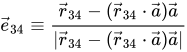
- Failed to parse (SVG (MathML can be enabled via browser plugin): Invalid response ("Math extension cannot connect to Restbase.") from server "https://wikimedia.org/api/rest_v1/":): {\displaystyle \vec{c} = \vec{a} \times \vec{b} }
- Failed to parse (SVG (MathML can be enabled via browser plugin): Invalid response ("Math extension cannot connect to Restbase.") from server "https://wikimedia.org/api/rest_v1/":): {\displaystyle e_{34} = (\cos \phi) \vec{a} + (sin \phi) \vec{c} }
For molecules with internal rotation degrees of freedom (e.g. n-alkanes), a torsional potential is usually modelled as:
- Failed to parse (SVG (MathML can be enabled via browser plugin): Invalid response ("Math extension cannot connect to Restbase.") from server "https://wikimedia.org/api/rest_v1/":): {\displaystyle V_{tors} \left(\phi\right) = \sum_{i=0}^n a_i \left( \cos \phi \right)^i }
or
- Failed to parse (SVG (MathML can be enabled via browser plugin): Invalid response ("Math extension cannot connect to Restbase.") from server "https://wikimedia.org/api/rest_v1/":): {\displaystyle V_{tors} \left(\phi\right) = \sum_{i=0}^n b_i \cos \left( i \phi \right) }