Curie's law
In a paramagnetic material Curie's law relates the magnetization of the material to the applied magnetic field and temperature.
- Failed to parse (SVG (MathML can be enabled via browser plugin): Invalid response ("Math extension cannot connect to Restbase.") from server "https://wikimedia.org/api/rest_v1/":): {\displaystyle \mathbf{M} = C \cdot \frac{\mathbf{B}}{T}}
- Failed to parse (SVG (MathML can be enabled via browser plugin): Invalid response ("Math extension cannot connect to Restbase.") from server "https://wikimedia.org/api/rest_v1/":): {\displaystyle \mathbf{M}} is the resulting magnetisation
- Failed to parse (SVG (MathML can be enabled via browser plugin): Invalid response ("Math extension cannot connect to Restbase.") from server "https://wikimedia.org/api/rest_v1/":): {\displaystyle \mathbf{B}} is the magnetic flux density of the applied field, measured in teslas
- Failed to parse (SVG (MathML can be enabled via browser plugin): Invalid response ("Math extension cannot connect to Restbase.") from server "https://wikimedia.org/api/rest_v1/":): {\displaystyle T} is absolute temperature, measured in kelvins
- Failed to parse (SVG (MathML can be enabled via browser plugin): Invalid response ("Math extension cannot connect to Restbase.") from server "https://wikimedia.org/api/rest_v1/":): {\displaystyle C} is a material-specific Curie constant
This relation was discovered experimentally (by fitting the results to a correctly guessed model) by Pierre Curie.
Simple Derivation (Statistical Mechanics)
A simple model of a paramagnet concentrates on the particles which compose it, call them paramagnetons. Assume that each paramagneton has a magnetic moment given by :Failed to parse (SVG (MathML can be enabled via browser plugin): Invalid response ("Math extension cannot connect to Restbase.") from server "https://wikimedia.org/api/rest_v1/":): {\displaystyle \vec{\mu}} . Energy of a magnetic moment in a magnetic field is given by
- Failed to parse (SVG (MathML can be enabled via browser plugin): Invalid response ("Math extension cannot connect to Restbase.") from server "https://wikimedia.org/api/rest_v1/":): {\displaystyle E=-\vec{\mu}\cdot\vec{B}}
To simplify the calculation, we are going to work with a 2-state paramagnet, that is, the particle can either align its magnetic moment with the magnetic field, or against it. No other orientations are possible, and Failed to parse (SVG (MathML can be enabled via browser plugin): Invalid response ("Math extension cannot connect to Restbase.") from server "https://wikimedia.org/api/rest_v1/":): {\displaystyle -\mu} . If so, then such particle has only two possible energies

- Failed to parse (SVG (MathML can be enabled via browser plugin): Invalid response ("Math extension cannot connect to Restbase.") from server "https://wikimedia.org/api/rest_v1/":): {\displaystyle E_0 = - \mu B}
and
- Failed to parse (SVG (MathML can be enabled via browser plugin): Invalid response ("Math extension cannot connect to Restbase.") from server "https://wikimedia.org/api/rest_v1/":): {\displaystyle E_1 = \mu B}
With this information we can construct the partition function of one paramagneton
- Failed to parse (SVG (MathML can be enabled via browser plugin): Invalid response ("Math extension cannot connect to Restbase.") from server "https://wikimedia.org/api/rest_v1/":): {\displaystyle Z = \sum_{n=0,1} e^{-E_n\beta} = e^{ \mu B\beta} + e^{-\mu B\beta} = 2 \cosh\left(\mu B\beta\right)}
When one seeks the magnetization of a paramagnet, one is interested in the likelihood of a paramagneton to align itself with the field. In other words, one seeks the expectation value of orientation Failed to parse (SVG (MathML can be enabled via browser plugin): Invalid response ("Math extension cannot connect to Restbase.") from server "https://wikimedia.org/api/rest_v1/":): {\displaystyle \mu} .
- Failed to parse (SVG (MathML can be enabled via browser plugin): Invalid response ("Math extension cannot connect to Restbase.") from server "https://wikimedia.org/api/rest_v1/":): {\displaystyle \left\langle\mu\right\rangle = \mu P\left(\mu_n\right) - \mu P\left(\mu_n\right) = {1 \over Z} \left( \mu e^{ \mu B\beta} - \mu e^{ - \mu B\beta} \right), }
where the probability of a configuration is given by its Boltzmann factor, and the partition function provides the necessary normalization for probabilities (so that the sum of all of them is unity.) A standard procedure is to express this as a derivative with respect to Failed to parse (SVG (MathML can be enabled via browser plugin): Invalid response ("Math extension cannot connect to Restbase.") from server "https://wikimedia.org/api/rest_v1/":): {\displaystyle \beta}
- Failed to parse (SVG (MathML can be enabled via browser plugin): Invalid response ("Math extension cannot connect to Restbase.") from server "https://wikimedia.org/api/rest_v1/":): {\displaystyle \left\langle\mu\right\rangle = {1 \over B Z} \partial_{\beta} ( e^{ \mu B\beta} + e^{ - \mu B\beta} ). }
But now what is differenciated is nothing but the partition function again. As Failed to parse (SVG (MathML can be enabled via browser plugin): Invalid response ("Math extension cannot connect to Restbase.") from server "https://wikimedia.org/api/rest_v1/":): {\displaystyle \partial_x \log y= (1/y) \partial_x y } , we can write
- Failed to parse (SVG (MathML can be enabled via browser plugin): Invalid response ("Math extension cannot connect to Restbase.") from server "https://wikimedia.org/api/rest_v1/":): {\displaystyle \left\langle\mu\right\rangle = {1 \over B } \partial_{\beta} \log Z = \mu \tanh\left(\mu B\beta\right)}
This is magnetization of one paramagneton, total magnetization of the solid is given by
Failed to parse (SVG (MathML can be enabled via browser plugin): Invalid response ("Math extension cannot connect to Restbase.") from server "https://wikimedia.org/api/rest_v1/":): {\displaystyle M = N\left\langle\mu\right\rangle = N \mu \tanh\left({\mu B\over k T}\right)}
The formula above is known as the Langevin Paramagnetic equation. Pierre Curie found an approximation to this law that applies to the reasonably high temperatures and low magnetic fields used in his experiments. Let's see what happens to the magnetization as we specialize it to large Failed to parse (SVG (MathML can be enabled via browser plugin): Invalid response ("Math extension cannot connect to Restbase.") from server "https://wikimedia.org/api/rest_v1/":): {\displaystyle T} and small Failed to parse (SVG (MathML can be enabled via browser plugin): Invalid response ("Math extension cannot connect to Restbase.") from server "https://wikimedia.org/api/rest_v1/":): {\displaystyle B} . As temperature increases and magnetic field decreases, the argument of hyperbolic tangent decreases. Another way to say this is
- Failed to parse (SVG (MathML can be enabled via browser plugin): Invalid response ("Math extension cannot connect to Restbase.") from server "https://wikimedia.org/api/rest_v1/":): {\displaystyle \left({\mu B\over k T}\right) << 1}
this is sometimes called the Curie regime. We also know that if Failed to parse (SVG (MathML can be enabled via browser plugin): Invalid response ("Math extension cannot connect to Restbase.") from server "https://wikimedia.org/api/rest_v1/":): {\displaystyle |x|<<1} , then
- Failed to parse (SVG (MathML can be enabled via browser plugin): Invalid response ("Math extension cannot connect to Restbase.") from server "https://wikimedia.org/api/rest_v1/":): {\displaystyle \tanh x \approx x}
so
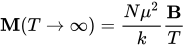
Q.E.D.
More Involved Derivation (Statistical Mechanics)
A more involved treatment applies when the paramagnetons are supposed to rotate freely. In this case, their position will be determined by their angles in spherical coordinates, and the energy for one of them will be:
- Failed to parse (SVG (MathML can be enabled via browser plugin): Invalid response ("Math extension cannot connect to Restbase.") from server "https://wikimedia.org/api/rest_v1/":): {\displaystyle E = - \mu B\cos\phi, }
where Failed to parse (SVG (MathML can be enabled via browser plugin): Invalid response ("Math extension cannot connect to Restbase.") from server "https://wikimedia.org/api/rest_v1/":): {\displaystyle \phi} is the angle between the magnetic moment and the magnetic field (which we take to be pointing in the Failed to parse (SVG (MathML can be enabled via browser plugin): Invalid response ("Math extension cannot connect to Restbase.") from server "https://wikimedia.org/api/rest_v1/":): {\displaystyle z} coordinate.) The corresponding partition function is
- Failed to parse (SVG (MathML can be enabled via browser plugin): Invalid response ("Math extension cannot connect to Restbase.") from server "https://wikimedia.org/api/rest_v1/":): {\displaystyle Z = \int_0^{2\theta} d\theta \int_0^{\pi}d\phi \sin\phi \exp( \mu B\beta \cos\phi).}
We seeing there is no dependence on the angle, and we can change variables to Failed to parse (SVG (MathML can be enabled via browser plugin): Invalid response ("Math extension cannot connect to Restbase.") from server "https://wikimedia.org/api/rest_v1/":): {\displaystyle y=\cos\phi} to obtain

- Failed to parse (SVG (MathML can be enabled via browser plugin): Invalid response ("Math extension cannot connect to Restbase.") from server "https://wikimedia.org/api/rest_v1/":): {\displaystyle Z = 2\pi \int_{-1}^ 1 d y \exp( \mu B\beta y) = 2\pi{\exp( \mu B\beta )-\exp(-\mu B\beta ) \over \mu B\beta }= {4\pi\sinh( \mu B\beta ) \over \mu B\beta .} }
Now, the expected value of the Failed to parse (SVG (MathML can be enabled via browser plugin): Invalid response ("Math extension cannot connect to Restbase.") from server "https://wikimedia.org/api/rest_v1/":): {\displaystyle z} component of the magnetization (the other two are seen to be null, as the should) will be given by
- Failed to parse (SVG (MathML can be enabled via browser plugin): Invalid response ("Math extension cannot connect to Restbase.") from server "https://wikimedia.org/api/rest_v1/":): {\displaystyle \left\langle\mu_z \right\rangle = {1 \over Z} \int_0^{2\theta} d\theta \int_0^{\pi}d\phi \sin\theta \mu\cos\phi \exp( \mu B\beta \cos\phi).}
Again, we see this can be written as a differenciation of :

- Failed to parse (SVG (MathML can be enabled via browser plugin): Invalid response ("Math extension cannot connect to Restbase.") from server "https://wikimedia.org/api/rest_v1/":): {\displaystyle \left\langle\mu_z\right\rangle = {1 \over Z B} \partial_\beta Z.}
Carrying out the derivation we find
- Failed to parse (SVG (MathML can be enabled via browser plugin): Invalid response ("Math extension cannot connect to Restbase.") from server "https://wikimedia.org/api/rest_v1/":): {\displaystyle \left\langle\mu_z\right\rangle = \mu L(\mu B\beta), }
where Failed to parse (SVG (MathML can be enabled via browser plugin): Invalid response ("Math extension cannot connect to Restbase.") from server "https://wikimedia.org/api/rest_v1/":): {\displaystyle L} is the Langevin function:
- Failed to parse (SVG (MathML can be enabled via browser plugin): Invalid response ("Math extension cannot connect to Restbase.") from server "https://wikimedia.org/api/rest_v1/":): {\displaystyle L(x)= \coth x -{1 \over x}.}
This function is not singular for small , since the two singular terms cancel each other. In fact, its behavior for small arguments is the same as the Failed to parse (SVG (MathML can be enabled via browser plugin): Invalid response ("Math extension cannot connect to Restbase.") from server "https://wikimedia.org/api/rest_v1/":): {\displaystyle \tanh} function, so the limit above also applies in this case.

Applications
It is the basis of operation of magnetic thermometers, that are used to measure very low temperatures.
This entry contains material taken from this wikipedia entry.