Inverse temperature
It is often convenient to define a dimensionless inverse temperature, :


This notation likely comes from its origin as a Lagrangian multiplier, for which Greek letters are customarily written.
Indeed, it shown in Ref. 1 (pp. 79-85) that this is the way it enters. The task is to maximize number of ways $N$ particles may be asigned to $K$ space-momentum cells, such that one has a set of occupation numbers . Introducing the partition function:

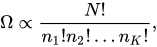
one could maximize its logarithm (a monotonous function):

where Stirling's approximation for large numbers has been used. The maximization must be performed subject to the constraint:

An additional constraint, which applies only to dilute gases, is:
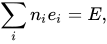
where is the total energy and is the energy of cell .


The method of Lagrange multipliers entails finding the extremum of the function

where the two Lagrange multipliers enforce the two conditions and permit the treatment of the occupations as independent variables. The minimization leads to
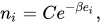
and an application to the case of an ideal gas reveals the connection with the temperature,

Similar methods are used for quantum statistics of dilute gases (Ref. 1, pp. 179-185).
References
- Kerson Huang, "Statistical Physics" John Wiley and Sons, second edition (1987) ISBN 978-0-471-81518-1