Continuity[edit]
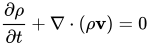
or, using the substantive derivative:
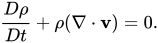
For an incompressible fluid,  is constant, hence the velocity field must be divergence-free:

Momentum[edit]
(Also known as the Navier-Stokes equation.)

or, using the substantive derivative:
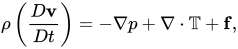
where  is a volumetric force (e.g.
  for gravity), and
  is the stress tensor.
Another form of the equation, more similar in form to the continuity equation, stresses the fact that the momentum density is conserved. For each of the three Cartesian coordinates  :
:

In vector form:

The term  is a dyad (direct tensor product).
The vector quantity  is the shear stress. For a Newtonian incompressible fluid,
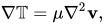
with  being the (dynamic) viscosity.
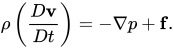
For an inviscid fluid, the momentum equation becomes Euler's equation for ideal fluids:
References[edit]