Carbon dioxide: Difference between revisions
Carl McBride (talk | contribs) (→Models: Added TraPPE parameters) |
Carl McBride (talk | contribs) (→EPM: Added parameters for the EPM models) |
||
| Line 5: | Line 5: | ||
The BBV (Bock, Bich and Vogel) model <ref>[http://dx.doi.org/10.1016/S0301-0104(00)00161-0 S. Bock, E. Bich and E. Vogel "A new intermolecular potential energy surface for carbon dioxide from ab initio calculations", Chemical Physics '''257''' pp. 147-156 (2000)]</ref>. | The BBV (Bock, Bich and Vogel) model <ref>[http://dx.doi.org/10.1016/S0301-0104(00)00161-0 S. Bock, E. Bich and E. Vogel "A new intermolecular potential energy surface for carbon dioxide from ab initio calculations", Chemical Physics '''257''' pp. 147-156 (2000)]</ref>. | ||
====EPM==== | ====EPM==== | ||
The elementary physical model (EPM) and EPM2 of Harris and Yung <ref>[http://dx.doi.org/10.1021/j100031a034 Jonathan G. Harris and Kwong H. Yung "Carbon Dioxide's Liquid-Vapor Coexistence Curve And Critical Properties as Predicted by a Simple Molecular Model", Journal of Physical Chemistry '''99''' pp. 12021-12024 (1995)]</ref> | |||
consists of [[Lennard-Jones model | 12-6 Lennard-Jones sites]] in conjunction with partial charges centred on each of these sites. | |||
{| style="width:80%; height:100px" border="1" | |||
|- | |||
| Model || <math>r_{\mathrm {OC}}</math> (Å)|| <math>k_{\theta}</math> kJ/mol/rad<sup>2</sup> ||<math>\sigma_{C-C}</math> (Å)|| <math>\epsilon_{C-C}/K</math> (K)||<math>\sigma_{O-O}</math> (Å)|| <math>\epsilon_{O-O}/K</math> (K)||<math>\sigma_{C-O}</math> (Å)|| <math>\epsilon_{C-O}/K</math> (K)|| q(O) (e) || q(C) (e) | |||
|- | |||
| EPM || 1.161 || 1275 || 2.785 || 28.999 || 3.064 || 82.997 || 2.921 || 49.060 || -0.33225 || +0.6645 | |||
|- | |||
| EPM2 || 1.149 || 1236 || 2.757 || 28.129 || 3.033 || 80.507 || 2.892 || 47.588 || -0.32560 || +0.6512 | |||
|} | |||
The bond bending potential is given by | |||
:<math> | |||
\Phi_{bend}(\theta) = \frac{1}{2} k_{\theta} \left( \theta - \theta_0 \right)^2 | |||
</math> | |||
where <math>\theta_0 = 180</math> degrees. | |||
====GCPCDO==== | ====GCPCDO==== | ||
Gaussian charge polarizable carbon dioxide (GCPCDO) model <ref>[http://dx.doi.org/10.1063/1.3519022 Rasmus A. X. Persson "Gaussian charge polarizable interaction potential for carbon dioxide", Journal of Chemical Physics '''134''' 034312 (2011)]</ref>. | Gaussian charge polarizable carbon dioxide (GCPCDO) model <ref>[http://dx.doi.org/10.1063/1.3519022 Rasmus A. X. Persson "Gaussian charge polarizable interaction potential for carbon dioxide", Journal of Chemical Physics '''134''' 034312 (2011)]</ref>. | ||
Revision as of 14:11, 26 May 2014
<jmol> <jmolApplet> <script>set spin X 10; spin on</script> <size>200</size> <color>lightgrey</color> <wikiPageContents>carbon_dioxide.pdb</wikiPageContents> </jmolApplet></jmol> |
Carbon dioxide (CO2)
Models
BBV
The BBV (Bock, Bich and Vogel) model [1].
EPM
The elementary physical model (EPM) and EPM2 of Harris and Yung [2] consists of 12-6 Lennard-Jones sites in conjunction with partial charges centred on each of these sites.
| Model | (Å) | kJ/mol/rad2 | (Å) | (K) | (Å) | (K) | (Å) | (K) | q(O) (e) | q(C) (e) |
| EPM | 1.161 | 1275 | 2.785 | 28.999 | 3.064 | 82.997 | 2.921 | 49.060 | -0.33225 | +0.6645 |
| EPM2 | 1.149 | 1236 | 2.757 | 28.129 | 3.033 | 80.507 | 2.892 | 47.588 | -0.32560 | +0.6512 |


The bond bending potential is given by
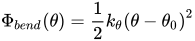
where degrees.

GCPCDO
Gaussian charge polarizable carbon dioxide (GCPCDO) model [3].
Murthy, Singer and McDonald
Murthy, Singer and McDonald proposed four models [4], two models (A1 and A2) consisting of two 12-6 Lennard-Jones sites located roughly on the oxygen atoms, plus a point quadrupole located at the molecular centre of mass. Model B differed from models A1 and A2 in the use of the 9-6 Lennard-Jones potential, and model C was a three site model using the Lorentz-Berthelot combining rules for the C-O interactions .
Oakley and Wheatley
The Oakley and Wheatley (OW) model [5].
SAPT-s
SAPT (symmetry-adapted perturbation theory) [6].
SYM
TraPPE
Parameters for CO2 for use in the TraPPE force field are C having K and Å with a partial charge of 0.70 e, and O having K and Å with a partial charge of -0.35 e [9]. The molecular geometry is rigid, linear, with a C-C bond length set at the experimental value of 1.16 Å. Unlike interactions use the Lorentz-Berthelot combining rules.


References
- ↑ S. Bock, E. Bich and E. Vogel "A new intermolecular potential energy surface for carbon dioxide from ab initio calculations", Chemical Physics 257 pp. 147-156 (2000)
- ↑ Jonathan G. Harris and Kwong H. Yung "Carbon Dioxide's Liquid-Vapor Coexistence Curve And Critical Properties as Predicted by a Simple Molecular Model", Journal of Physical Chemistry 99 pp. 12021-12024 (1995)
- ↑ Rasmus A. X. Persson "Gaussian charge polarizable interaction potential for carbon dioxide", Journal of Chemical Physics 134 034312 (2011)
- ↑ C. S. Murthy, K. Singer, and I. R. McDonald "Interaction site models for carbon dioxide", Molecular Physics 44 pp. 135-143 (1981)
- ↑ Mark T. Oakley and Richard J. Wheatley "Additive and nonadditive models of vapor-liquid equilibrium in CO2 from first principles", Journal of Chemical Physics 130 034110 (2009)
- ↑ Robert Bukowski, Joanna Sadlej, Bogumil Jeziorski, Piotr Jankowski, Krzysztof Szalewicz, Stanislaw A. Kucharski, Hayes L. Williams, and Betsy M. Rice "Intermolecular potential of carbon dioxide dimer from symmetry-adapted perturbation theory", Journal of Chemical Physics 110 pp. 3785- (1999)
- ↑ Kuang Yu, Jesse G. McDaniel, and J. R. Schmidt "Physically Motivated, Robust, ab Initio Force Fields for CO2 and N2", Journal of Physical Chemistry B 115 pp. 10054-10063 (2011)
- ↑ Kuang Yu and J. R. Schmidt "Many-body effects are essential in a physically motivated CO2 force field", Journal of Chemical Physics 136 034503 (2012)
- ↑ Jeffrey J. Potoff and J. Ilja Siepmann "Vapor–liquid equilibria of mixtures containing alkanes, carbon dioxide, and nitrogen", AIChE Journal 47 pp. 1676-1682 (2001)
Related reading
- Trevor G. Gibbons and Michael L. Klein "Thermodynamic properties for a simple model of solid carbon dioxide: Monte Carlo, cell model, and quasiharmonic calculations", Journal of Chemical Physics 60 pp. 112-126 (1974)
- R. Eggenberger, S. Gerber, and H. Huber "The carbon dioxide dimer", Molecular Physics 72 pp. 433-439 (1991)
- L. Glasser "Equations of state and phase diagrams", Journal of Chemical Education 79 874 (2002)
- Z. Zhang and Z. Duan "An optimized molecular potential for carbon dioxide", Journal of Chemical Physics 122 214507 (2005)
- B. M. Mognetti, L. Yelash, P. Virnau, W. Paul, K. Binder, M. Müller, and L. G. MacDowell "Efficient prediction of thermodynamic properties of quadrupolar fluids from simulation of a coarse-grained model: The case of carbon dioxide", Journal of Chemical Physics 128 104501 (2008)
- B. M. Mognetti, M. Oettel, P. Virnau, L. Yelash, and K. Binder "Structure and pair correlations of a simple coarse grained model for supercritical carbon dioxide", Molecular Physics 107 pp. 331-341 (2009)
- A. Herráez, R. M. Hanson, and L. Glasser "Interactive 3D phase diagrams using Jmol" Journal of Chemical Education 86: 566 (2009) and website
- G. Pérez-Sánchez, D. González-Salgado, M. M. Piñeiro, and C. Vega "Fluid-solid equilibrium of carbon dioxide as obtained from computer simulations of several popular potential models: The role of the quadrupole", Journal of Chemical Physics 138 084506 (2013)